Journal · Ingredients & Science
Is Niacinamide Allergy Real? What Most Breakouts Are Actually From
Niacinamide allergy is rare in dermatology. Most breakouts blamed on niacinamide trace to vehicle ingredients or fungal flares — here's how to tell which.

Maria Otworowska, PhD, Co-founder of Skin Bliss
· 9 min read
True niacinamide allergy is exceptionally rare in dermatology. Only a handful of confirmed cases turn up across decades of patch-test literature. Most reactions blamed on niacinamide trace to vehicle ingredients further down the bottle, fungal acne flares, or a damaged skin barrier amplifying any active you put on top of it.
You added a 10% niacinamide serum to your routine. Two weeks in, your jawline broke out. You blacklisted niacinamide for good. The molecule probably didn't deserve it.
Key Takeaways
Is Niacinamide Allergy Actually Real?
Real, immune-mediated allergy to niacinamide is documented but extremely rare. A 2022 systematic review of vitamin allergic contact dermatitis turned up only a handful of confirmed cases linked to niacinamide itself; most of the case-report literature points to nicotinic acid esters (benzyl, methyl, propyl nicotinate) used in muscle rubs and warming masks 1. The Cosmetic Ingredient Review's 2005 safety assessment of niacin and niacinamide concluded it was not a sensitizer and produced no stinging up to 10% concentration in clinical testing 2. The North American Contact Dermatitis Group doesn't even include it on the standard patch-test panel. That's a quiet signal it's not common enough to merit tracking.
So when someone says they're allergic to niacinamide, there's almost always a different explanation. That's where it gets useful.
Why Does Niacinamide Seem to Break Some People Out?
Most "niacinamide breakouts" trace to one of three things: the vehicle, a fungal flare, or a compromised barrier reacting to any active applied on top of it.
Niacinamide is rarely sold as a single-ingredient serum. The bottle also contains solubilizers, thickeners, emollients, and preservatives. Several of those are known food sources for Malassezia, the yeast that causes fungal acne 3: polysorbates (especially polysorbate 80), PEG-fatty-acid esters, and certain medium-chain fatty alcohols. Malassezia metabolizes C11–C24 fatty acids; niacinamide itself doesn't feed it, but the supporting cast often does. The bumps that follow look like acne but are usually fungal folliculitis. Small uniform papules on the forehead, jawline, or chest.
The molecule on the front of the bottle is the loudest. It isn't always the one causing the problem.
What About "Purging" From Niacinamide?
Purging is a retinoid mechanism. Tretinoin and its cousins accelerate keratinocyte turnover, which forces existing microcomedones to the surface faster. That's the temporary breakout people experience in weeks 2–6 of a retinoid. Niacinamide doesn't do that. It supports ceramide, free fatty acid, and cholesterol synthesis 4, improving barrier function over time, but it doesn't speed up cell turnover. So if you broke out two weeks into a niacinamide serum, that wasn't purging.
It was something else, most likely a vehicle ingredient, a fungal flare, or your barrier reacting to a new formulation. "Wait it out" advice that works for retinoids doesn't transfer here. If the reaction persists past two weeks, the formula isn't going to grow on you. Stop using it and audit the ingredient list.
What's the Difference Between Flushing, Stinging, and a Real Reaction?
Different reactions have different causes and different fixes. Mistaking one for another leads to wrong conclusions about whether you can tolerate niacinamide at all.
| Pattern | What it likely is | Timing | What to do |
|---|---|---|---|
| Diffuse warm pink across cheeks, gone in 1–2 hours | Flush, likely from trace nicotinic acid in a degraded formula | Within 15–30 min of applying | Buy fresh, properly stored niacinamide |
| Stinging that fades when washed off | Vehicle or low pH on a compromised barrier | Immediate, transient | Repair the barrier first, then retry |
| Itchy, scaly, red patches 24–72h after | Allergic contact dermatitis (rare; usually a co-ingredient) | Delayed, day 2–3 | See a dermatologist for patch testing |
| New uniform papules on forehead, jawline, or chest after 1–4 weeks | Vehicle-driven Malassezia flare | Slow build | Switch to a fungal-safe formulation |
| Comedones from a new serum | Comedogenic carrier oils in the same product | Slow build | Audit the full INCI |
The flush specifically is worth understanding. Niacinamide itself can't activate the receptor (GPR109A) that causes flushing. Only nicotinic acid can 5. If your face flushed, the formula degraded. Niacinamide hydrolyzes to nicotinic acid under heat, moisture, and time, especially at pH extremes. Buy a fresh bottle from a reputable brand and the flush usually disappears.
What About the Niacinamide and Vitamin C Myth?
You've probably read that you can't pair niacinamide with vitamin C because they neutralize each other or convert into niacin. This came from 1960s pharmaceutical stability data using non-stabilized formulations at high temperature for extended time. It does not happen in your bathroom with modern formulas.
Decades of contemporary cosmetic chemistry have shown the two ingredients are compatible at standard skincare conditions. There is one practical note: ascorbic acid serums sit at low pH (around 3.5), and applying anything immediately on top can sting if your barrier is already compromised. That's a barrier issue. Wait a minute or two between layers, or use them at different times of day, and the so-called "incompatibility" disappears entirely. Skin Bliss's Ingredient Compatibility Checker flags layering issues that are evidence-backed instead of skincare folklore.
Who Is Most Likely to React to Niacinamide?
Three groups should pay extra attention, but none of them are likely to develop a true allergy.
People with a compromised barrier (over-exfoliated skin, recent retinoid initiation, eczema flare) will absorb any active more deeply. The same 5% serum that's invisible on intact skin can sting on stripped skin. Repair the barrier first, then layer.
People with seborrheic dermatitis or fungal acne tendencies should look at the vehicle. Niacinamide-containing serums often include polysorbates and fatty alcohols that feed Malassezia. The fix is choosing a formula without those vehicle ingredients.
People with rosacea actually do well on niacinamide. A 2005 randomized trial showed a niacinamide-containing moisturizer improved barrier function and reduced symptoms in rosacea patients 6. The flushing some of them fear comes from nicotinic acid. Niacinamide is a different molecule with a different receptor.
What Should You Do If You Think Niacinamide Is Breaking You Out?
Slow down before you blacklist a molecule that the dermatology literature treats as one of the lowest-risk actives in skincare.
Audit the full ingredient list, beyond the headline. Look for polysorbate 80, PEG-fatty-acid esters, and medium-chain fatty alcohols (cetearyl alcohol, isostearyl alcohol). If your bumps are uniform small papules clustered on the forehead, jawline, or chest, you're more likely reacting to a fungal flare than to niacinamide.
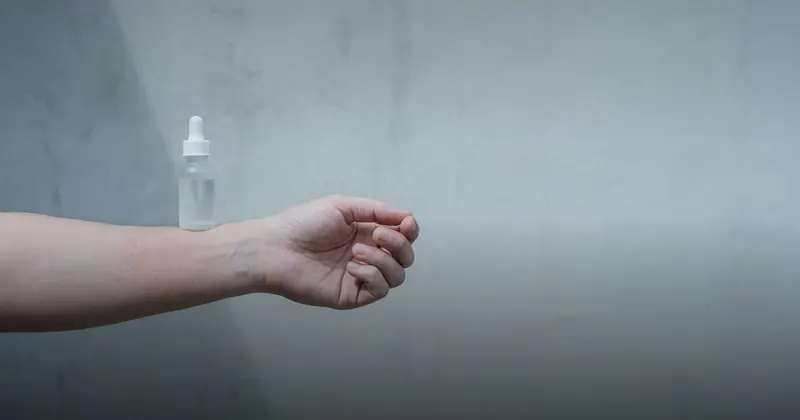
Patch test before reintroducing. Apply to the inner forearm for 48–72 hours before going back to the face, especially if your barrier is compromised. This applies to any new active.
Drop the concentration. The peer-reviewed benefit data peaks around 4–5%; doubling to 10% doesn't double the benefit and raises irritation reports. Start at 2–4% and reintroduce every other day for two weeks before going daily.
Use a tool to audit your shelf. The Skin Bliss app's Shelf Analysis can scan your products and flag fungal-acne triggers, comedogenic carriers, and ingredient redundancies in seconds.
Frequently Asked Questions
Can niacinamide cause fungal acne?
Niacinamide itself doesn't feed Malassezia. The yeast metabolizes C11–C24 fatty acids; niacinamide isn't on its menu. What can feed it are vehicle ingredients in many niacinamide serums: polysorbates, PEG-fatty-acid esters, and certain fatty alcohols. If you broke out in uniform small papules on the forehead or jawline, audit the full ingredient list rather than blaming the headline molecule.
Why does my face turn red after applying niacinamide?
Niacinamide can't activate the receptor that causes flushing. Only nicotinic acid (free niacin) can. If your face flushes from a niacinamide serum, the formula has likely degraded, allowing some niacinamide to convert to nicotinic acid in the bottle. Buy fresh, properly stored product or switch brands.
Is 10% niacinamide too strong?
For most healthy skin, no. The Cosmetic Ingredient Review found no stinging up to 10% in clinical testing. But the benefit data peaks around 4–5%. If you're getting reactions on a 10% serum, dropping to 2–4% rarely costs you efficacy and often resolves the irritation.
How can I tell if I'm flushing or breaking out from niacinamide?
A flush is diffuse, warm, pink, and resolves within 1–2 hours with no bumps. A breakout is comedonal or papular, builds over days, and persists. Different mechanisms, different fixes. If you're not sure, take a photo at hour one and again at 24 hours.
Should I get patch tested for niacinamide allergy?
Only if you've had repeated, well-documented eczematous reactions to multiple niacinamide products with different vehicles. Standard contact dermatitis panels don't include niacinamide because confirmed cases are rare. Reactions to nicotinic acid esters in muscle rubs are more common and worth flagging to a dermatologist if you've reacted to those products too.
Save this for the next time someone says they can't use niacinamide. Most of the time, it's the rest of the bottle they're reacting to.

In your browser
Free Skin Quiz: Understand your skin profile in under 5 minutes
Oily or dry is only the start. Find out what your skin actually needs across six skin dimensions, with a plain note on what each one means for your routine. Results appear in your browser, and you can keep them in the app.

Maria combines her background in AI research with a passion for evidence-based skincare. She built Skin Bliss to help people make informed decisions about their skin, backed by science rather than marketing.
Sources (6)
- Foti C et al. (2022). "Allergic contact dermatitis from vitamins: A systematic review." *Health Science Reports*.
- Andersen FA (2005). "Final Report of the Safety Assessment of Niacinamide and Niacin." *International Journal of Toxicology*.
- Rubenstein RM, Malerich SA (2014). "Malassezia (Pityrosporum) Folliculitis." *Journal of Clinical and Aesthetic Dermatology*.
- Tanno O et al. (2000). "Nicotinamide increases biosynthesis of ceramides as well as other stratum corneum lipids by stimulating sphingolipid synthesis." *British Journal of Dermatology*.
- Hanson J et al. (2010). "Nicotinic acid- and monomethyl fumarate-induced flushing involves GPR109A." *Journal of Clinical Investigation*.
- Draelos ZD et al. (2005). "The effect of a niacinamide-containing facial moisturizer on skin barrier and rosacea." *Cutis*.