Skin Bliss: Understanding the Skin Scores
How to read Skin Type and Skin Concern scores in Skin Bliss: why they are relative to category and profile, and what a low score really means

Maria Otworowska, PhD, Co-founder of Skin Bliss
· 4 min read

When you open a product in Skin Bliss and see something like 22%, the first reaction is usually the same: wait, is this bad for me?
Almost always, the answer is no. Scores in Skin Bliss are relative, not absolute, and understanding what they actually measure is the difference between using the app well and scaring yourself away from a perfectly fine product.
The two scores you see
Every product gets broken into two headline numbers.
Skin Type Score. How well the formula fits your base skin type. Some products are clearly labeled "for oily skin" or "for dry skin," but most live somewhere in between, and a "normal to dry" moisturizer fits different profiles very differently. Our system captures that nuance, rating how strongly aligned the product is with your skin type, not just whether the marketing mentions it.
Skin Concern Score. Whether the product contains ingredients that target the concerns you flagged (acne, redness, pigmentation, signs of aging, dehydration, etc.). We look at two things: whether the beneficial ingredient is present at all, and whether it's likely at a useful concentration. A product with a trace of niacinamide in the preservative layer doesn't get the same score as one that uses it at an active level.
Together, these two scores answer: does this product fit my type, and does it move the needle on what I'm trying to fix?
Why the numbers are relative
Skin Bliss doesn't rate products in isolation. It rates them in the context of your profile and the rest of the catalog in the same category.
So when you view a moisturizer's score, you're seeing how it performs compared to all other moisturizers for your specific skin type and concerns. Not on some universal "good versus bad" scale. That distinction matters, because a product can be perfectly fine and still score low simply because there are better matches in the same aisle.
A quick example
Say you open the app and your profile is:
- Dry skin
- Acne-prone
- Eczema-prone
When you look at cleansers, Skin Bliss finds every cleanser in the catalog and asks, for each one, how suitable is this cleanser for dry skin? For acne-prone skin? For eczema-prone skin? Some products are great at one thing and okay at the others. A few hit all three. Most are stronger in one direction than another.
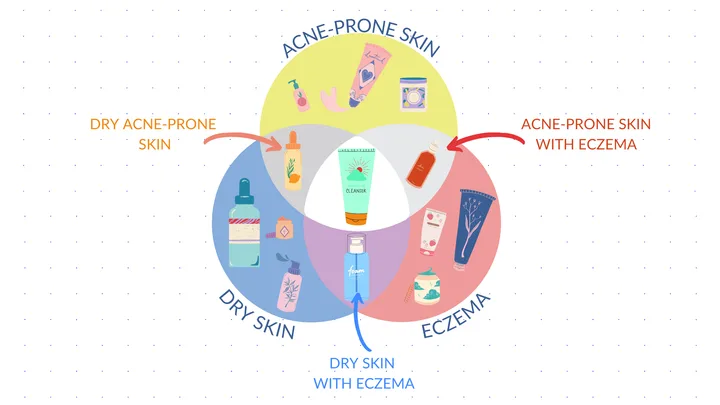
The app then ranks all of those cleansers head-to-head across your three priorities, doing hundreds of pairwise comparisons in the background (is Cleanser A more or less suitable than Cleanser B for dry skin? For acne? For eczema?). What you see as a percentage is where a specific product lands in that ranked list.
The result:
- If a product is at the top of the ranking for your profile, it scores close to 100%.
- If it's in the middle of the pack, the score lands somewhere around 50 to 70%.
- If most other cleansers in the category are better suited to your needs, it may show as 10 to 20%.
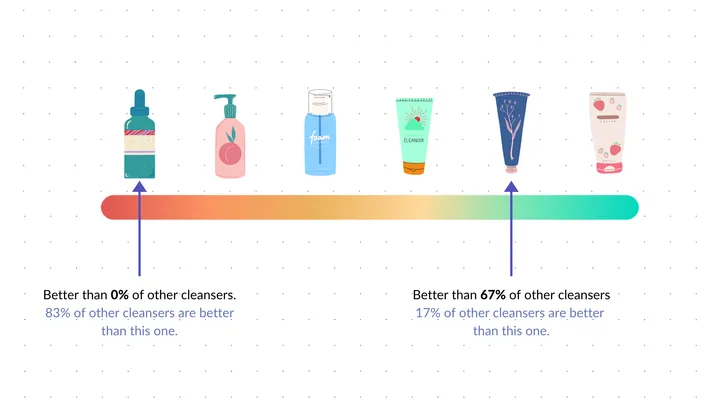
In the second illustration above, Cleanser A scores 0% not because it's harmful, but because every other cleanser in the comparison is a closer fit for dry skin. Cleanser D scores 67% because four out of six cleansers in the set are a worse match than it is. It's all relative.
What you should not assume
A low score is not a health warning.
- 12% does not mean the product will hurt your skin. It means there are better-ranked options in the same category for your profile.
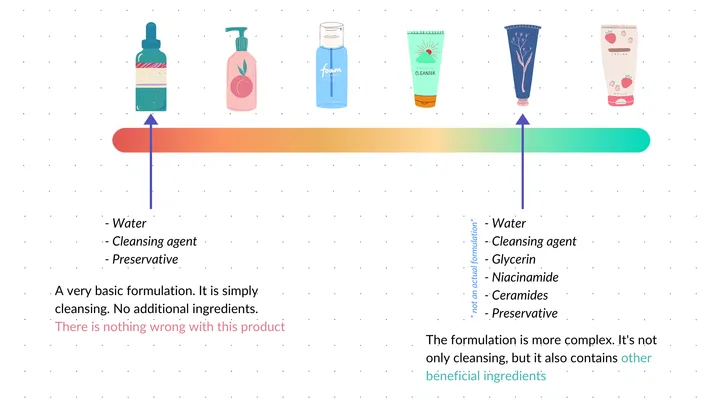
- A low score does not mean the product is poorly formulated. It may just not be tailored to your specific needs. Plenty of well-made products are wrong for specific skin types, and that's what the ranking is reflecting.
- A high score is not a universal endorsement. It means the product is a strong match for your profile in that category, not that it would work equally well for someone with different skin.
The question the score actually answers
Skin Bliss scores are context-aware. They reflect your individual skin, your stated concerns, and the realistic shape of the product landscape in each category.
So when you see a score, don't ask is this bad? Ask is this the best fit for me, in this category, right now? And if the answer is no, tap in and see why. The app will show you which dimension pulled the number down, and from there you can decide whether it matters for your routine or whether the product still earns a spot on your shelf.
That's the useful way to read a number in Skin Bliss.

In your browser
Free Skin Quiz: Understand your skin profile in under 5 minutes
Oily or dry is only the start. Find out what your skin actually needs across six skin dimensions, with a plain note on what each one means for your routine. Results appear in your browser, and you can keep them in the app.

Maria combines her background in AI research with a passion for evidence-based skincare. She built Skin Bliss to help people make informed decisions about their skin, backed by science rather than marketing.