Journal · Devices, Body & Lifestyle
How Smart Rings Track the Biometrics That Predict Your Skin Quality
How smart rings track sleep, HRV, and skin temperature, biometrics that may predict skin quality and reveal how lifestyle changes affect your complexion

Maria Otworowska, PhD, Co-founder of Skin Bliss
· 8 min read
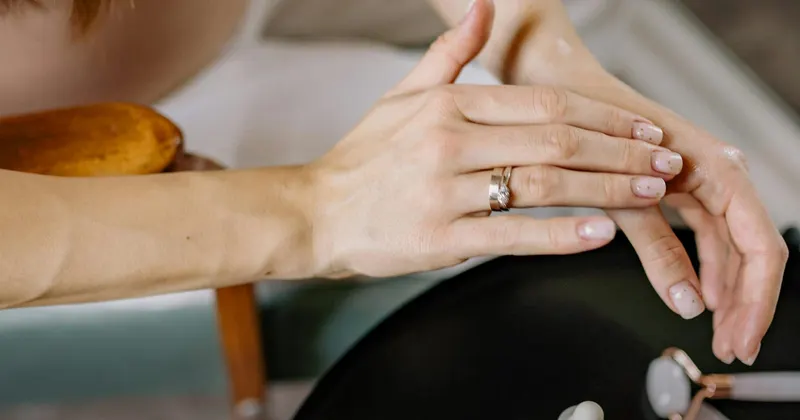
Smart ring skin health tracking is the practice of using a wearable ring device to continuously monitor biometric signals like sleep quality, heart rate variability, skin temperature, and stress levels, all of which directly influence how your skin looks and repairs itself over time.
Your skin is not just a surface. It is a real-time reflection of what is happening inside your body. Poor sleep, chronic stress, hormonal shifts -- these internal signals show up on your face as dullness, breakouts, and accelerated aging long before you notice them in the mirror. Smart rings sit at the intersection of health tech and skincare because they measure exactly the metrics that predict skin quality.

Key Takeaways
What biometrics do smart rings actually measure?
Smart rings use photoplethysmography (PPG) sensors, accelerometers, and temperature sensors packed into a titanium band worn 24/7. The data they collect falls into six categories that matter for skin health. Sleep duration and quality tell you how much repair time your skin gets each night. HRV measures your autonomic nervous system balance, which directly correlates with inflammation levels. Resting heart rate flags systemic stress. Skin temperature tracks hormonal cycles. Recovery scores estimate how well your body bounced back from the previous day. And activity levels influence circulation, which affects nutrient delivery to skin cells.
The Oura Ring Gen3, the most studied consumer smart ring, has been validated against polysomnography (the gold standard for sleep measurement) in a study of 96 participants across over 421,000 data epochs. It achieved 91.7% overall accuracy for sleep detection, with no significant differences from clinical equipment for total sleep time, sleep onset latency, or time spent in deep sleep 1. That is clinical-grade data on your finger.
Why does sleep quality predict skin health?
Sleep is when your skin does its heaviest repair work. During deep sleep (stages III and IV), your pituitary gland releases the largest pulse of growth hormone you will get all day. In men, about 70% of growth hormone secretion during sleep occurs specifically during slow-wave sleep 4. Growth hormone also stimulates collagen synthesis in skin fibroblasts, and higher doses have been shown to increase both collagen content and mechanical strength of skin tissue 5.
Poor sleep does visible damage. A clinical study found that chronic poor sleep quality is associated with increased signs of intrinsic aging, diminished skin barrier function, and lower satisfaction with appearance 6. Another study showed that just one day of sleep deprivation significantly worsened skin gloss, elasticity, and wrinkle depth 7. Your smart ring sleep score is, in a very real sense, a preview of what your skin will look like in two weeks.
How does heart rate variability connect to skin inflammation?
Heart rate variability measures the variation in time between consecutive heartbeats. Higher HRV means your autonomic nervous system is flexible, resilient, and better at managing stress. Lower HRV means your body is stuck in a sympathetic (fight-or-flight) state, which drives chronic low-grade inflammation. That inflammation is terrible for skin.
Research using wearable devices has confirmed that HRV is a powerful biomarker for autonomic nervous system function, and that real-time HRV monitoring can detect stress responses that correlate with cortisol elevation 2. A separate study found a negative correlation between cortisol levels and HRV index in stressful environments 8. When your HRV drops and stays low, cortisol rises. And cortisol is one of the most damaging hormones for your skin.
Stress hormones reduce the synthesis and accelerate the degradation of hyaluronan and proteoglycans by approximately 40% 3. These are the molecules that keep your skin plump and hydrated. A 2024 clinical study confirmed that chronic moderate psychological stress significantly impacts skin aging parameters including DNA integrity, extracellular matrix synthesis, and skin barrier function 9.
What does skin temperature tracking reveal about your complexion?
Smart rings measure skin temperature continuously from your finger, typically to within 0.1 degrees Celsius. While this is not the same as facial skin temperature, it tracks core body temperature patterns that reflect hormonal fluctuations. For people who menstruate, the temperature rise after ovulation (driven by progesterone) is clearly visible in smart ring data. This matters for skin because progesterone increases sebum production, which is why many people notice breakouts in the luteal phase of their cycle.
Tracking these patterns over several months gives you a predictive window. If you know your temperature shift happens on day 15, you can preemptively adjust your skincare. Use lighter moisturizers, add a gentle salicylic acid cleanser, and avoid heavy occlusives during the days when your skin is most likely to produce excess oil. A generic skincare calendar cannot do this for you.
How can you turn biometric data into better skin?
Numbers on a screen do not fix your skin. Here is how to actually use smart ring metrics. Start by wearing the ring consistently for two weeks without changing anything. This builds your personal baseline. Then look at three key correlations. When your sleep score drops below your personal average for three or more consecutive nights, expect your skin to look duller and feel rougher about ten days later. When your HRV trends downward for a week, expect increased redness or sensitivity. When your recovery scores stay below 50% for several days, your skin repair capacity is compromised.
The Skin Bliss Skin Diary is a good companion tool here. Log your biometric trends alongside daily skin observations, and within a month you will start seeing the cause-and-effect patterns that are unique to your body. Some people see breakouts two days after a bad sleep stretch. Others see them ten days later. Your personal lag time is the key to making this predictive rather than reactive.
| Biometric | What it predicts for skin | Your target range | Warning sign |
|---|---|---|---|
| Sleep score | Collagen repair capacity | Above 85 | Below 70 for 3+ nights |
| HRV (RMSSD) | Inflammation and stress resilience | Above 30 ms | Drop of 20% or more from baseline |
| Resting heart rate | Systemic stress load | 60-75 bpm | Spike of 10+ bpm without exercise |
| Skin temperature | Hormonal cycle and barrier shifts | Stable within 0.5 degrees C | Variation exceeding 1 degree C |
| Recovery score | Cellular repair readiness | Above 70% | Below 50% for 3+ consecutive days |
Frequently Asked Questions
Do smart rings actually improve skin or just track it?
Smart rings are tracking devices, not treatments. They do not directly change your skin. What they do is give you objective data about the internal factors (sleep, stress, recovery) that scientific research has shown to affect skin quality. The improvement comes from using that data to make targeted lifestyle changes. Think of it like a scale for weight management -- the scale does not make you lose weight, but it tells you whether what you are doing is working.
Which smart ring is best for skin health tracking?
The Oura Ring Gen3 has the most published validation research, with studies confirming 91.7% sleep tracking accuracy and reliable HRV measurement 110. The Samsung Galaxy Ring and RingConn are newer alternatives with similar sensor suites but less published clinical validation. For skin-specific use, prioritize sleep tracking accuracy and temperature monitoring over activity features.
How long before biometric changes show up on your skin?
Most people see a lag of seven to fourteen days between a biometric shift and a visible skin change. A stretch of poor sleep this week shows up as dullness or breakouts next week. This delay is why tracking matters. By the time you see the problem on your face, the cause happened days ago. Smart ring data helps you intervene before the skin symptoms appear.
Can a smart ring replace a dermatologist?
No. Smart rings track lifestyle metrics that influence skin health, but they cannot diagnose skin conditions, detect skin cancer, or prescribe treatments. They are a complementary tool for understanding how your daily habits affect your complexion. If you have persistent skin concerns, see a board-certified dermatologist.

In your browser
Free Skin Quiz: Understand your skin profile in under 5 minutes
Oily or dry is only the start. Find out what your skin actually needs across six skin dimensions, with a plain note on what each one means for your routine. Results appear in your browser, and you can keep them in the app.

Maria combines her background in AI research with a passion for evidence-based skincare. She built Skin Bliss to help people make informed decisions about their skin, backed by science rather than marketing.
Sources (10)
- Altini M, Kinnunen H. (2024). "Validity and reliability of the Oura Ring Generation 3 (Gen3) with Oura sleep staging algorithm 2.0 when compared to multi-night ambulatory polysomnography." *Sleep*.
- Hernando D et al. (2022). "Associations between Sleep Quality and Heart Rate Variability: Implications for a Biological Model of Stress Detection Using Wearable Technology." *Sensors*.
- Kato Y et al. (2019). "Stress, immunity and skin collagen integrity: evidence from animal models and clinical conditions." *Brain, Behavior, and Immunity*.
- Van Cauter E, Plat L. (1996). "Physiology of growth hormone secretion during sleep." *Journal of Pediatrics*.
- Jorgensen PH et al. (1989). "Growth hormone influences collagen deposition and mechanical strength of intact rat skin. A dose-response study." *Acta Endocrinologica*.
- Oyetakin-White P et al. (2015). "Does poor sleep quality affect skin ageing?" *Clinical and Experimental Dermatology*.
- Lee S et al. (2019). "A study of skin characteristics with long-term sleep restriction in Korean women in their 40s." *Skin Research and Technology*.
- Seo S et al. (2024). "Integrated mental stress smartwatch based on sweat cortisol and HRV sensors." *Biosensors and Bioelectronics*.
- Deshayes N et al. (2024). "Impact of Chronic Moderate Psychological Stress on Skin Aging: Exploratory Clinical Study and Cellular Functioning." *Journal of Investigative Dermatology*.
- Cao R et al. (2022). "Accuracy Assessment of Oura Ring Nocturnal Heart Rate and Heart Rate Variability in Comparison With Electrocardiography." *JMIR mHealth and uHealth*.