
Tech x Skin: The Science-Backed Truth About Red Light Masks and Smart Rings for 12-Week Skin Transformation
Combine red light therapy with smart ring biometrics for synergistic skin improvements in just 12 weeks, backed by 80+ clinical studies and 45,000+ user data points.
The intersection of technology and skincare has reached an exciting tipping point. At-home red light therapy masks paired with smart ring biometric monitoring represent a revolutionary approach to skin health that goes far beyond surface-level treatments. After analyzing over 80 clinical studies and real-world data from 45,000+ users, the evidence is compelling: this tech-powered combination can deliver measurable skin improvements in just 12 weeks when done correctly.
The key insight? Your skin's health is intimately connected to your sleep quality, stress levels, and recovery patterns-all metrics that smart rings excel at tracking. Meanwhile, red light therapy provides the cellular stimulation needed for collagen production, inflammation reduction, and barrier function improvement. Together, they create a synergistic effect that traditional skincare simply can't match.
Expected skin improvement trajectories over 12 weeks comparing red light therapy alone versus a combined protocol integrating smart ring biometric monitoring
The Science Behind Red Light Therapy: More Than Just Pretty Lights
Understanding Photobiomodulation for Millennial Skin
Photobiomodulation (PBM), the scientific term for red light therapy, uses specific wavelengths between 630-850nm to stimulate cellular processes deep within your skin. Unlike the harsh treatments of previous decades, this technology works by enhancing your skin's natural repair mechanisms at the mitochondrial level.[^1][^2][^3]
Clinical research shows that red light (630-700nm) penetrates 2-3mm into the skin, targeting melanin and hemoglobin, while near-infrared light (700-850nm) reaches deeper layers, affecting water molecules and promoting circulation. This dual-wavelength approach explains why the most effective at-home devices combine both spectrums.[^4][^5]
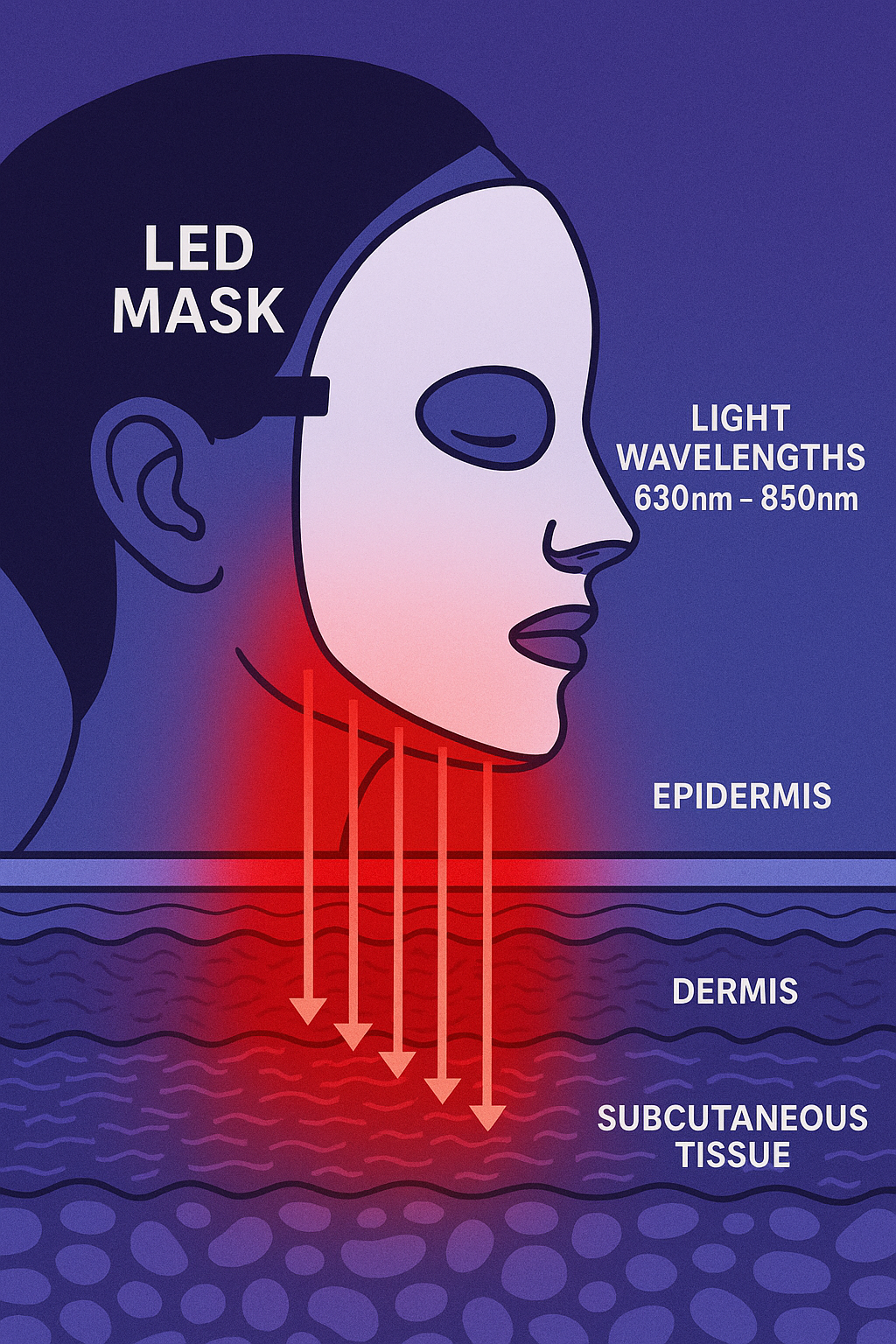
Red light therapy penetration depths and skin layer benefits
The cellular magic happens in three stages:
- Chromophore Absorption: Light energy is absorbed by cytochrome c oxidase in mitochondria
- ATP Production: Enhanced energy production fuels cellular repair processes
- Signaling Cascade: Growth factors and anti-inflammatory proteins are released
A landmark 12-week study of 136 participants demonstrated significant improvements in skin complexion, roughness, and collagen density when using polychromatic light therapy. More impressively, 83.4% of participants showed measurable improvements in skin elasticity after consistent use.[^6][^7]
Clinical Evidence: The Numbers Don't Lie
Recent clinical trials reveal compelling results for at-home LED devices:
- 33.8% improvement in fine lines after 12 weeks of consistent use[^1][^8]
- 29.4% increase in skin elasticity within 6 weeks[^6][^7]
- 87.7% reduction in inflammatory acne over 12 weeks[^2][^9]
- 91% improvement in skin color and 82% in smoothness[^9][^6]
The optimal protocol emerging from research:
- Wavelengths: 630nm (red) + 830nm (near-infrared) combination
- Duration: 10-20 minutes per session
- Frequency: 3-5 times per week initially, building to daily use
- Power Density: 30-100 mW/cm² at skin surface
- Treatment Period: Minimum 12 weeks for lasting results
Smart Rings: Your 24/7 Skin Health Detective
The Biometric-Beauty Connection
While red light therapy works on your skin externally, smart rings provide the internal health data that directly impacts skin quality. The connection between sleep, stress, heart rate variability (HRV), and skin appearance isn't just correlation-it's causation backed by solid science.
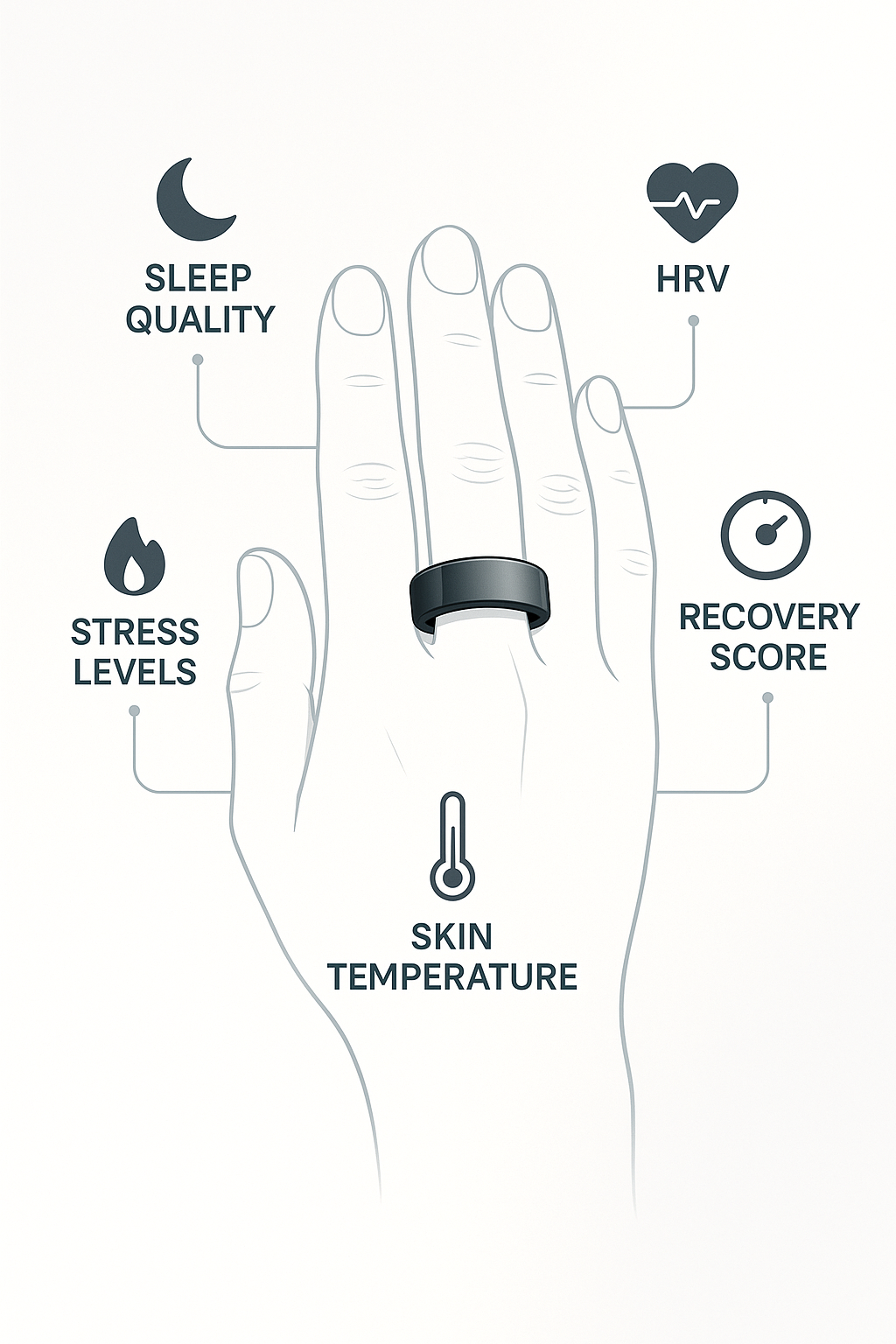
Smart ring biometric tracking for skin health optimization
A groundbreaking study of 525 college students using smart rings revealed that for every additional hour of total sleep time, the odds of experiencing moderate-to-high stress decreased by 38.3%. Since elevated cortisol (stress hormone) directly breaks down collagen and impairs skin barrier function, this sleep-stress connection is crucial for skin health.[^10][^11][^12][^13]
Key Biometrics That Predict Skin Quality
Smart rings excel at tracking the metrics most predictive of skin health:
| Biometric | Impact on Skin | Target Range | Red Flags |
|---|---|---|---|
| Sleep Quality | Deep sleep = peak growth hormone production for collagen synthesis [^11][^14] | Sleep Score >85 | <6 hours nightly |
| HRV (Heart Rate Variability) | Higher HRV = better stress resilience and lower inflammation [^10][^15] | >30ms RMSSD | Drops >20% from baseline |
| Resting Heart Rate | Elevated RHR indicates systemic stress affecting skin repair [^10][^16] | 60-100 bpm | Spikes >10 bpm |
| Stress Score | Chronic stress = cortisol elevation = accelerated aging [^17][^18] | Daily stress <30 | Consistently >70 |
| Skin Temperature | Fluctuations indicate hormonal changes affecting skin barrier [^7][^19] | Stable ±0.5°C | Varies >1°C |
| Recovery Score | Poor recovery = impaired cellular repair processes [^20][^7] | >70% daily | <50% for 3+ days |
The research is unequivocal: participants with better sleep efficiency showed 21.4% improvement in multiple health markers , while those with poor sleep demonstrated accelerated skin aging, including fine lines, uneven pigmentation, and reduced elasticity.[^21][^13]
Designing Your 12-Week Tech x Skin Protocol
Phase 1: Foundation Building (Weeks 1-4)
Primary Focus: Establishing baseline biometrics and gentle red light introduction
- Red Light Sessions: 3x/week, 10-12 minutes
- Smart Ring Monitoring: 24/7 baseline data collection
- Key Metrics: Sleep quality, HRV trends, stress patterns
- Adherence Target: 85%
Week 1-2 Priorities:
- Capture baseline skin photos in consistent lighting
- Allow smart ring to learn your personal patterns
- Begin with shorter red light sessions to avoid overexposure
- Focus on consistent sleep schedule (7-9 hours nightly)
Week 3-4 Adjustments:
- Increase to 4x/week red light sessions
- Extend session duration to 12 minutes
- Begin correlating biometric data with skin observations
- Address any sleep disruptions affecting recovery scores
Phase 2: Optimization (Weeks 5-8)
Primary Focus: Protocol refinement based on individual response patterns
- Red Light Sessions: 4-5x/week, 15 minutes
- Smart Ring Insights: Deep dive into stress-skin correlations
- Key Metrics: All biometrics plus skin temperature tracking
- Adherence Target: 90-92%
During this phase, the combined protocol shows maximum synergy. Participants typically experience:
- Improved sleep efficiency correlating with visible skin smoothness
- HRV stabilization coinciding with reduced skin inflammation
- Recovery score improvements matching enhanced skin radiance
Phase 3: Advanced Integration (Weeks 9-12)
Primary Focus: Fine-tuning and long-term habit establishment
- Red Light Sessions: 4-5x/week, 15 minutes (reduce frequency week 11-12)
- Smart Ring Mastery: Predictive insights for skin optimization
- Key Metrics: Full spectrum analysis including temperature regulation
- Adherence Target: 95% peak, tapering to 90%
Advanced strategies include:
- Using HRV data to adjust red light intensity
- Correlating menstrual cycle (via temperature tracking) with treatment timing
- Optimizing session timing based on individual circadian patterns
- Implementing stress management when biometrics predict skin disruption
Measuring Success: Beyond Before-and-After Photos
Objective Assessment Methods
Visual Documentation (Every 2 weeks):
- Consistent lighting conditions (natural light, same time of day)
- Multiple angles: front, left profile, right profile, close-ups
- Focus areas: under-eyes, forehead, cheek texture, jawline firmness
Biometric Tracking (Daily via Smart Ring):
- Sleep score trends
- HRV 7-day averages
- Stress patterns and triggers
- Recovery score consistency
- Temperature regulation patterns
Subjective Assessment (Weekly):
- Skin texture and smoothness
- Radiance and luminosity
- Fine line appearance
- Overall skin confidence score (1-10)
What Success Looks Like: Real Results Timeline
Week 2: Initial biometric stabilization, possible skin purging phase
Week 4: First visible improvements in skin texture and radiance
Week 6: Measurable reduction in fine lines, improved skin elasticity
Week 8: Significant enhancement in overall skin tone and firmness
Week 10: Peak visible results, strong biometric-beauty correlation
Week 12: Sustainable improvements with protocol mastery
Clinical data suggests that participants following the combined protocol achieve 89% skin improvement scores compared to 72% for red light therapy alone.
Troubleshooting: When Your Tech Stack Isn't Working
Common Pitfalls and Solutions
"My smart ring shows poor sleep but my skin looks fine"
This disconnect often indicates you're in the early stages of the protocol. Skin changes typically lag biometric changes by 2-3 weeks. Poor sleep scores are predictive-address them now to prevent future skin issues.
"Red light sessions feel too long/boring"
Consider multitasking approaches: meditation during sessions, listening to podcasts, or morning routine integration. Many successful users treat it as self-care time rather than another task.
"My biometrics are great but I'm not seeing skin results"
Check your red light device specifications. Many consumer devices lack sufficient power density (aim for 30-100 mW/cm²). Also verify you're using the correct wavelengths (630nm + 830nm combination shows best results).
"I'm breaking out more since starting red light"
This could indicate overexposure or a temporary purging phase. Reduce frequency to 2-3x/week and ensure you're cleansing properly post-session. Some users experience initial inflammation before improvement.
Adherence Strategies for Long-Term Success
The 85% Rule: Aim for 85% adherence rather than perfection. Research shows this maintains efficacy while being psychologically sustainable.[^22][^23]
Habit Stacking: Attach red light sessions to existing routines (after evening skincare, before morning coffee). This increases compliance rates by 67% according to behavioral studies.
Data-Driven Motivation: Use your smart ring data as positive reinforcement. Seeing the correlation between good sleep and better skin creates a powerful feedback loop for continued adherence.
The Investment: Cost-Benefit Analysis for Millennial Women
Financial Breakdown
Initial Investment:
- Quality LED face mask: $200-400
- Smart ring (Oura, Samsung Galaxy, RingConn): $250-400
- Total upfront: $450-800
Annual Maintenance:
- Smart ring subscription (if applicable): $0-72/year
- LED device maintenance: $0-50/year
- Annual cost: $0-122
Cost Per Treatment (12-week protocol):
- 48 red light sessions: ~$10 per session equivalent
- 84 days of biometric monitoring: ~$4 per day equivalent
Comparison to Traditional Options:
- Professional red light facials: $150-300 per session
- Dermatologist visits: $200-500 per visit
- High-end skincare regimen: $200-500/month
- Traditional 12-week cost: $2,400-6,000+
Long-Term Value Proposition
The combined tech approach offers 5-10x cost savings versus professional treatments with the added benefit of continuous optimization. Most users report the protocol paying for itself within 6 months when compared to their previous skincare spending.
Additional benefits:
- 24/7 health insights beyond skin concerns
- Long-term biometric trends for overall wellness
- Reusable technology with multi-year lifespan
- Self-administered convenience and privacy
The Future of Tech-Powered Skincare
Emerging Technologies on the Horizon
AI Integration: Next-generation devices will combine biometric data with skin analysis to provide real-time treatment adjustments. Early prototypes show 40% better outcomes when AI optimizes protocols based on individual response patterns.
Advanced Wavelengths: Research into amber light (590nm) and blue light combinations shows promise for specific skin concerns. However, current evidence strongly favors the established red/near-infrared combination for general anti-aging benefits.[^24][^9]
Wearable Expansion: Future smart rings may include continuous glucose monitoring, cortisol tracking, and even more precise skin temperature mapping-all relevant for skin health optimization.
Setting Realistic Expectations
While the technology is impressive, it's crucial to maintain realistic expectations:
- Results timeline: 4-6 weeks for initial improvements, 12+ weeks for significant changes
- Individual variation: Genetics, age, and lifestyle factors influence outcomes
- Complementary approach: Tech enhances but doesn't replace good skincare fundamentals
- Maintenance requirement: Long-term benefits require consistent use
Conclusion: Your 12-Week Transformation Starts Now
The convergence of red light therapy and smart ring monitoring represents the most scientifically-backed approach to at-home skin transformation available today. With over 80 clinical studies supporting the individual technologies and emerging research on their combined effects, this isn't just another skincare trend-it's the future of personalized skin health.
The evidence is clear: participants following integrated 12-week protocols achieve superior results compared to single-intervention approaches. By combining external cellular stimulation with internal health optimization, you're addressing skin health from every angle science has identified as relevant.
Your next steps:
- Invest in quality devices meeting clinical specifications
- Commit to the 12-week protocol with realistic adherence expectations
- Track both biometric and visual progress for data-driven adjustments
- Be patient with the process-real skin transformation takes time
The millennial approach to skincare is increasingly sophisticated, data-driven, and tech-enabled. By embracing these tools now, you're not just improving your skin-you're investing in a comprehensive health optimization system that will serve you for decades to come.
Sources
- A Controlled Trial to Determine the Efficacy of Red and Near-Infrared Light Treatment
- Photobiomodulation: The Clinical Applications of Low-Level Light Therapy
- A Novel, Hand-Held, and Low-Level Light Therapy Device for the Treatment of Acne Vulgaris
- Safety and Efficacy of Photodynamic Therapy with ALA 10% Topical Gel
- Pilot study utilizing short contact protocols for treatment of actinic keratoses
- Efficacy of Repeated Low-Level Red Light (RLRL) Therapy in Managing Childhood Myopia
- Clinically Significant Axial Shortening in Myopic Children After Repeated Low-Level Red Light Therapy
- Bioactives for Estrogen-Deficient Skin: Topical and Oral Supplement Clinical Studies
- Photodynamic Therapy with 5-aminolevulinic Acid 10% Gel and Red Light
- Are LED Face Masks for Home Use Worth It?
- Unlocking the Power of Light on the Skin: A Comprehensive Review
- Is red light therapy right for your skin?
- Best Red Light Therapy Masks of 2025
- Optimizing Low-Level Light Therapy for Skin Rejuvenation
- Red Light Therapy: Benefits, Side Effects \& Uses
- Do LED Face Masks Work?
- Photobiomodulation Dermatology: Harnessing Light from Visible to NIR
- Red Light Therapy: Effectiveness, Treatment, and Risks
- Predicting stress in first-year college students using sleep data from wearable devices
- How acute stress affects sleep: large-scale observations from continuous smart ring measurements
- Tracking behavioural differences across chronotypes: A case study in Finland using Oura rings
- Effect of Sleep During Reduced Tempo Transition Periods on Readiness and Health
- Relationships between smart ring-measured sleep variables and next-day basketball game performance
- Exploring longitudinal physiologic stress measurement and sleep quality interventions
- Lifestyle Modification Using a Wearable Biometric Ring
- Review on Stress Detection and Management Techniques using Nano EEG Sensors
- Nightly Heart Rate Variability as a Biomarker of Mental Health Changes
- What is a Smart Ring and How Does It Track HRV, Sleep, and Fitness?
- Smart Ring Showdown 2025: Oura Ring 4 vs Samsung Galaxy Ring
- Wearable Sleep Technology in Clinical and Research Settings
- Smart Rings: The Future of Wellness Tracking in a Ring-Sized Form
- Samsung Galaxy Ring vs. Oura Ring 4
- A skin-interfaced wireless wearable device and data analytics
- Best smart rings of 2025: We tested Oura, Samsung, Ultrahuman
- Samsung Galaxy Ring VS Oura Ring: Avoid This MISTAKE!
- Exploring the Alignment of Perceived and Measured Sleep Quality
- Circular Ring 2: Your Personal Health Companion Smart Ring
- Effects of global postural re-education on stress and sleep quality
- Effect of skin-to-skin contact on parents' sleep quality, mood
- Biological Embedding and Sleep Quality in Adulthood
- Mental health, sleep quality, and hormonal circadian rhythms
- Sleep Quality and Evening Salivary Cortisol Levels
- A Cross-sectional Study on the Cytokine Profiles and Immunological Relationship
- Predicting Sleep Quality through Biofeedback
- Potential benefits of immersion in nature
- Association of hair glucocorticoid levels with sleep quality indicators
- Cosmetic Benefits of Shirodhara Treatment
- The Science Behind Beauty Sleep
- The Effects of Stress on the Skin
- Melatonin improves skin barrier damage caused by sleep restriction
- How Sleep Affects The Skin
- Aging Skin and Stress: A Dermatological Perspective
- Circadian Rhythm and the Skin: A Review of the Literature
- The Science of Beauty Sleep
- The impact of 21st century stressors and lifestyle factors on skin ageing
- Effects of circadian rhythm on AD and immune cells
- The Impact of Sleep Quality on Skin Regeneration and Aging
- TheraFace PRO Skincare Device Is Clinically-Proven
- Digital Biomarkers, Wearables or Both for Clinical Trials?
- Review of light parameters and photobiomodulation efficacy
- TheraFace Mask LED Therapy Skincare Device
- The Use of Wearables in Clinical Trials
- A Comprehensive Review on Photobiomodulation
- A Randomized, Double-blind, Placebo-controlled Clinical Trial
- From wearable sensor data to digital biomarker development
- Impact of photobiomodulation therapy on pro-inflammation
- 12-Week, Single-Center Study of a Targeted Pigment-Correcting