Journal · Sun Protection & Longevity
Should You Use Vitamin C Under Sunscreen?
Why vitamin C serum belongs under sunscreen, not over it, and how layering antioxidants with SPF may give you stronger daily defense against UV damage

Maria Otworowska, PhD, Co-founder of Skin Bliss
· 9 min read
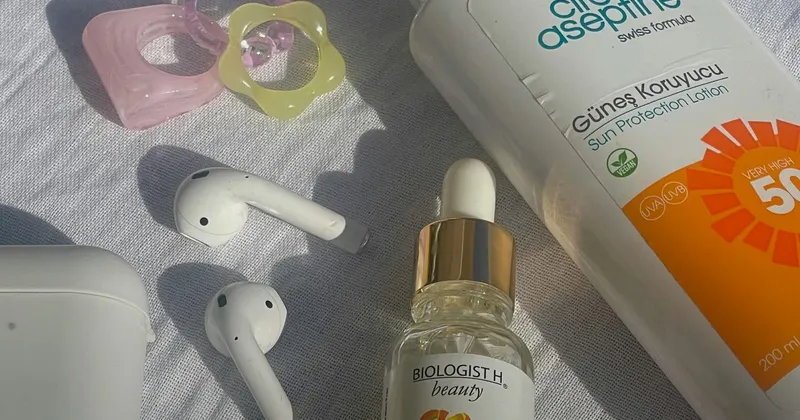
Vitamin C serum under sunscreen is a layering strategy that pairs a topical antioxidant, typically L-ascorbic acid at 10-20% concentration, with broad-spectrum UV protection to create a dual-defense system where the antioxidant neutralizes free radicals that sunscreen alone cannot block, providing measurably greater photoprotection than either product used on its own.
This combination is one of the most evidence-backed morning routines in dermatology. It is not marketing synergy or influencer advice. Peer-reviewed research shows that topical vitamin C provides additional UV protection through a completely different mechanism than sunscreen filters, and when the two are layered, the protection is additive or even greater than additive against certain types of UV damage 12.
Key Takeaways
Why does vitamin C belong under sunscreen, not over it?
Vitamin C needs direct contact with skin to penetrate. L-ascorbic acid, the most studied form of topical vitamin C, requires a low pH (below 3.5) to cross the stratum corneum and enter the epidermis 4. If you apply it over sunscreen, the sunscreen layer acts as a physical barrier that prevents absorption. The vitamin C sits on top doing very little.
When applied first, vitamin C absorbs into the skin within about 60-90 seconds. After that, it is in the tissue, not on the surface. Your sunscreen layer goes on top without interfering with the vitamin C that has already penetrated. Research on percutaneous absorption found that tissue levels of ascorbic acid were saturated after three daily applications, with a half-life of about 4 days in the skin 4. That means the vitamin C is working from within even after you wash your face.
How do vitamin C and sunscreen protect skin through different mechanisms?
Sunscreen filters, whether mineral (zinc oxide, titanium dioxide) or chemical (avobenzone, octisalate), work at the surface. They block, absorb, or scatter UV photons before those photons reach living skin cells. But no sunscreen blocks 100% of UV radiation. Some always gets through.
Vitamin C operates inside the skin. It is an antioxidant that donates electrons to neutralize the free radicals UV radiation generates in your cells. These reactive oxygen species (ROS) are what actually cause collagen breakdown, DNA mutations, and pigmentation changes. A study on topical antioxidants and photoprotection showed that vitamin C is capable of additive protection against UVB damage when combined with a UVB sunscreen, and when paired with a UVA sunscreen, the protection was greater than additive 1.
| Factor | Sunscreen | Vitamin C serum |
|---|---|---|
| Where it works | Skin surface | Inside the epidermis |
| How it works | Blocks/absorbs UV photons | Neutralizes free radicals after UV entry |
| Duration | Until reapplication (2 hours) | ~4 days in tissue after absorption 4 |
| What it misses | Some UV still penetrates | Does not block UV directly |
| Optimal combo | Provides first line of defense | Catches what sunscreen misses |
Think of sunscreen as a wall and vitamin C as a cleanup crew inside the building. You want both.
What concentration and form of vitamin C works best?
L-ascorbic acid is the gold standard. It is the form with the most clinical evidence for photoprotection, brightening, and collagen support 5. Effective concentrations range from 10-20%, with maximal percutaneous absorption occurring at 20% 4. Going higher than 20% does not increase skin levels and may increase irritation.
Stability is the main challenge with L-ascorbic acid. It oxidizes when exposed to air and light, turning yellow or brown and losing potency. Ferulic acid solves part of this problem. A landmark study showed that adding 0.5% ferulic acid to a solution of 15% L-ascorbic acid and 1% alpha-tocopherol (vitamin E) doubled the photoprotection from 4-fold to approximately 8-fold 3. That formulation, often referred to as CEF or C E Ferulic, became the basis for many of the high-performance vitamin C serums available today.
If L-ascorbic acid irritates your skin, ascorbyl glucoside and magnesium ascorbyl phosphate are gentler alternatives, though they convert to ascorbic acid more slowly and the clinical evidence for photoprotection is weaker. For most skin types, starting at 10% L-ascorbic acid and building to 15-20% over a few weeks is a reasonable approach. The Skin Bliss Ingredient Compatibility Checker can help confirm that your vitamin C serum works well alongside your other morning products.
Disclaimer: Vitamin C at low pH can cause tingling on first use. Patch test on your inner forearm for 24 hours before applying to your face. If you are using other actives in the morning (like AHAs or BHAs), introduce vitamin C on alternate days to avoid over-irritation. Always wear SPF when using vitamin C, as with any active ingredient.
Does vitamin C serum help with dark spots and uneven skin tone?
Yes. Vitamin C inhibits tyrosinase, the enzyme that drives melanin production 5. A systematic review of topical vitamin C for melasma and photoaging found that it is effective for reducing hyperpigmentation and improving uneven skin tone, though it typically requires 8-12 weeks of consistent use to see noticeable results 6. The brightening effect is gradual, not dramatic overnight.
When paired with sunscreen, the depigmenting effect is stronger because you are simultaneously reducing new pigment formation (vitamin C) and preventing UV from triggering more melanin production (sunscreen). Skipping the sunscreen while using vitamin C for brightening is counterproductive, since UV exposure will generate more pigmentation than the vitamin C can counteract.
What is the correct layering order for a vitamin C and sunscreen morning routine?
Keep it simple. Cleanser, vitamin C serum, moisturizer (optional), sunscreen. That is it.
Step 1: Wash your face with a gentle cleanser and pat dry. Your skin should be clean and slightly damp.
Step 2: Apply 4-5 drops of vitamin C serum to your fingertips. Press gently into your face, covering forehead, cheeks, nose, and chin. Avoid the eyelids if you experience stinging. Wait 60-90 seconds for absorption.
Step 3: If your skin is dry, apply a lightweight moisturizer. If your sunscreen is hydrating enough, you can skip this step.
Step 4: Apply a generous layer of broad-spectrum SPF 30 or higher. Use approximately a nickel-sized amount for your face. Mineral and chemical sunscreens both work well over vitamin C. Reapply every two hours during sun exposure.
The wait time between vitamin C and sunscreen matters. Rushing the layers can cause pilling, where products ball up on the surface instead of absorbing. Sixty seconds is usually sufficient.
Frequently Asked Questions
Can I use vitamin C serum with niacinamide?
Yes. The old advice that vitamin C and niacinamide cancel each other out is based on chemistry that does not reflect real-world product use. At the pH levels found in modern formulations, these ingredients coexist without issues. Many dermatologists recommend using both in the same routine.
Will vitamin C make my skin more sensitive to the sun?
No. Vitamin C is an antioxidant, not a photosensitizer. It actually provides additional protection against UV-induced damage 1. Unlike retinoids or AHAs, it does not thin the stratum corneum or increase UV sensitivity. However, you should still wear sunscreen daily for full protection.
How do I know if my vitamin C serum has gone bad?
Fresh L-ascorbic acid serum is clear or very pale yellow. If it has turned dark yellow, orange, or brown, it has oxidized significantly and its potency is reduced. An oxidized serum may also cause more irritation than a fresh one. Store your serum in a cool, dark place, and replace it every 2-3 months after opening.
Can I use vitamin C serum if I have sensitive or rosacea-prone skin?
Start with a lower concentration (5-10%) and a more stable derivative like ascorbyl glucoside. L-ascorbic acid at 15-20% and a pH below 3.5 can be too aggressive for reactive skin. Apply every other day initially and increase frequency as your skin tolerates it. If redness or burning persists beyond the first week, the product may not be right for your skin.
Do I still need to reapply vitamin C throughout the day?
No. Once vitamin C has absorbed into your skin, it stays active for approximately 4 days 4. A single morning application is sufficient. You do need to reapply your sunscreen every two hours during sun exposure, but the vitamin C layer underneath continues working without reapplication.

In your browser
Free Skin Quiz: Understand your skin profile in under 5 minutes
Oily or dry is only the start. Find out what your skin actually needs across six skin dimensions, with a plain note on what each one means for your routine. Results appear in your browser, and you can keep them in the app.

Maria combines her background in AI research with a passion for evidence-based skincare. She built Skin Bliss to help people make informed decisions about their skin, backed by science rather than marketing.
Sources (7)
- Darr D et al. (1996). "Effectiveness of antioxidants (vitamin C and E) with and without sunscreens as topical photoprotectants." *Acta Derm Venereol*.
- Lin JY et al. (2003). "UV photoprotection by combination topical antioxidants vitamin C and vitamin E." *J Am Acad Dermatol*.
- Lin FH et al. (2005). "Ferulic acid stabilizes a solution of vitamins C and E and doubles its photoprotection of skin." *J Invest Dermatol*.
- Pinnell SR et al. (2001). "Topical L-ascorbic acid: percutaneous absorption studies." *Dermatol Surg*.
- Pullar JM et al. (2017). "Topical Vitamin C and the Skin: Mechanisms of Action and Clinical Applications." *Nutrients*.
- Lima PB et al. (2023). "Efficacy of topical vitamin C in melasma and photoaging: A systematic review." *J Cosmet Dermatol*.
- Murray JC et al. (2008). "A topical antioxidant solution containing vitamins C and E stabilized by ferulic acid provides protection for human skin against damage caused by ultraviolet irradiation." *J Am Acad Dermatol*.