
Your Skincare Routine Might Be Breaking Your Skin: 5 Signs of Barrier Damage
Your routine has 10 steps, three actives, and a dedicated exfoliation night. You are doing everything the internet says is right. So why does your face sting every time you apply moisturizer? That ...
Your routine has 10 steps, three actives, and a dedicated exfoliation night. You are doing everything the internet says is right. So why does your face sting every time you apply moisturizer?
That burning sensation is not a sign that your products are "working." It is your skin barrier -- the outermost layer of your skin, technically called the stratum corneum -- telling you it has been compromised. And the fix is probably the opposite of what you think.
What your skin barrier actually does
Think of the barrier as a brick wall. The "bricks" are dead skin cells (corneocytes), and the "mortar" is a lipid matrix made of ceramides, cholesterol, and fatty acids. When this wall is intact, it:
- Locks in moisture by preventing trans-epidermal water loss (TEWL) - Blocks irritants, pollutants, and bacteria from reaching deeper skin layers - Maintains a slightly acidic pH (4.5-5.5) that naturally inhibits pathogen growth - Regulates inflammation by keeping immune responses in check
When the wall cracks, everything that is supposed to stay out gets in -- and everything that is supposed to stay in leaks out.
5 signs your barrier is failing
If more than one of these sounds familiar, barrier damage is the likely culprit:
- Products that used to be fine now sting. Even basic, fragrance-free moisturizer burns on contact 2. Breakouts that feel "reactive." More like inflamed bumps than traditional clogged pores -- they come and go unpredictably 3. Persistent redness. Your skin looks flushed even when you are not using any products 4. Constant tightness. No matter how much cream you layer on, your skin still feels dry and restricted 5. New sensitivities. Products you have used safely for years suddenly cause itching, rashes, or hot spots
The red flag combination? Stinging plus breakouts. That specific duo almost always points to structural barrier damage, not a product allergy.
Why "treating" the breakouts makes it worse
Here is where most people go wrong: they see the reactive breakouts and reach for stronger actives. More salicylic acid. More benzoyl peroxide. More scrubbing.
This is exactly backwards.
If your barrier is compromised, adding acids to damaged skin triggers more inflammation -- which causes more breakouts. You end up in a cycle where you are treating the symptom by worsening the cause.
To fix the breakouts, you have to fix the barrier first. You do not need more actives. You need lipids.
The four things that damage your barrier
Barrier damage rarely happens overnight. It builds up when your routine exceeds your skin's repair capacity:
- Over-exfoliation: Using AHAs, BHAs, or physical scrubs too frequently strips away the lipid matrix your barrier depends on - Harsh cleansers: High-pH foaming cleansers dissolve protective oils and shift your skin's pH toward alkaline, which encourages bacterial growth - Active overload: Layering retinoids, vitamin C, and acids in the same routine gives your skin no time to recover between exposures - Environmental stress: Cold, wind, dry air, and UV radiation accelerate water loss and weaken the barrier's physical structure
The repair protocol: three products, zero actives
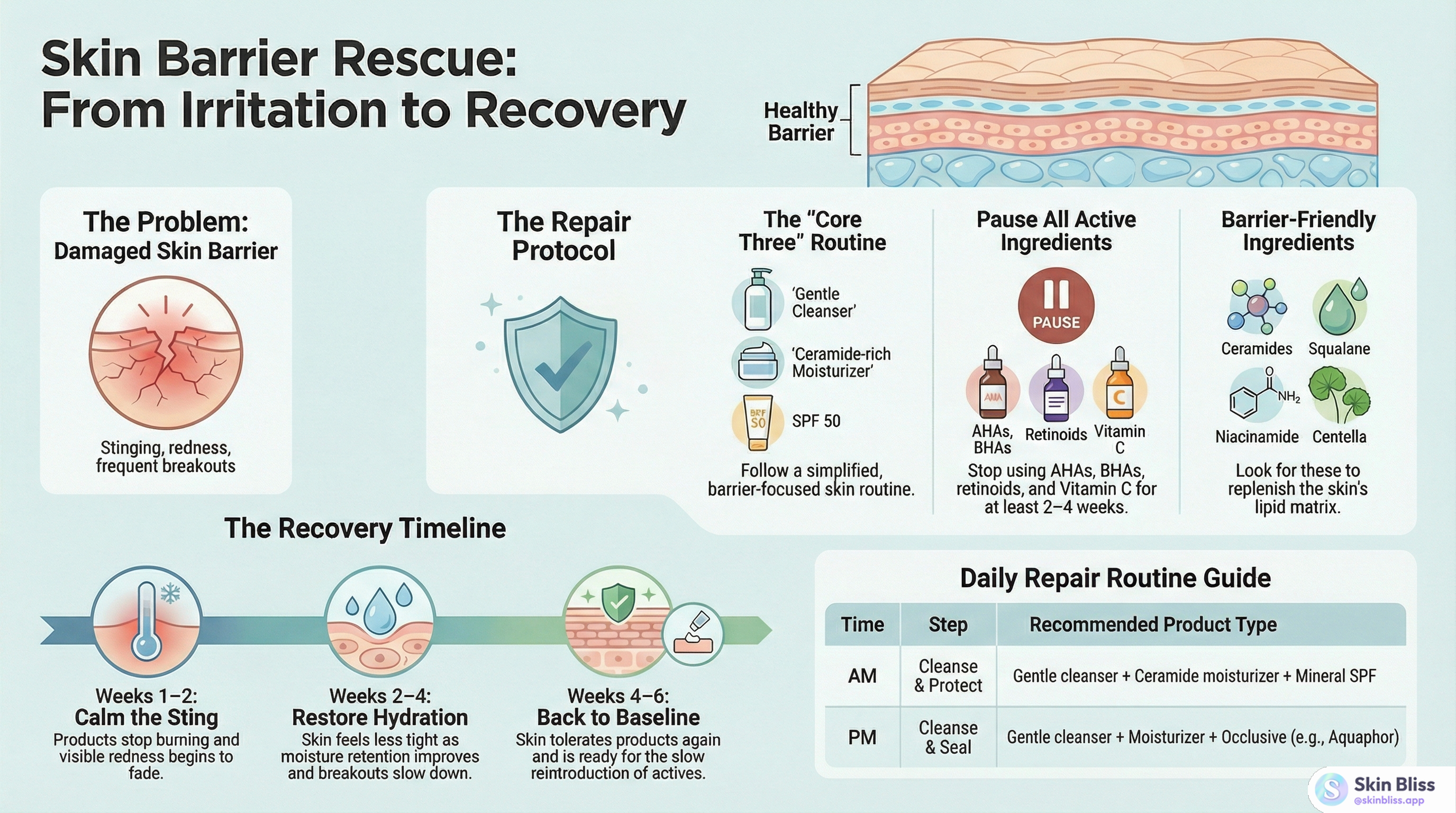
Repairing a damaged barrier means going from "treating" to "protecting." The first step is non-negotiable: stop all actives. That means pausing retinoids, AHAs, BHAs, and vitamin C until your skin has recovered.
Your entire routine should be three products:
- Gentle cleanser -- look for non-foaming, creamy formulas that do not leave skin feeling "squeaky clean" (that squeaky feeling means stripped lipids). A low-pH, fragrance-free option works best 2. Restorative moisturizer -- one loaded with barrier-repair ingredients (more on that below) 3. Mineral SPF -- UV exposure slows barrier recovery, so sun protection is part of the healing process
A note on double cleansing: Only double-cleanse in the evening if you wore heavy makeup or water-resistant sunscreen. If your skin is extremely sensitized, a single gentle wash is enough.
Ingredients that actually rebuild the barrier
Your routine should be boring. Your product formulas should not. Look for these biological building blocks:
- Ceramides -- the essential lipids that "glue" skin cells together, directly replenishing the damaged mortar between cells - Fatty acids and squalane -- mimic your skin's natural sebum to restore oil balance - Niacinamide (vitamin B3) -- helps because it actually boosts your skin's own ceramide production, not just as a topical band-aid - Centella asiatica and panthenol -- anti-inflammatory actives that speed cellular repair without irritating compromised skin
Important warning about slugging: Sealing in moisture with an occlusive layer (like squalane oil or Aquaphor over moisturizer) can help during barrier repair. But never slug over active ingredients like retinol or acids -- the occlusion increases penetration and can cause chemical burns on weakened skin. Save it for your "boring" recovery nights only.
What recovery actually looks like: a 6-week timeline
Skin turnover cannot be rushed. Here is what to expect when you commit to the repair protocol:
- Weeks 1-2: Less stinging. The burning sensation fades as microscopic cracks in your barrier start to close - Weeks 2-3: Hydration returns. TEWL slows down. Your skin feels less tight and starts holding onto its own moisture - Weeks 3-4: Breakouts slow. As pH normalizes and inflammation drops, the reactive breakouts start clearing - Weeks 4-6: Back to baseline. Your skin can tolerate products again. Only now is it safe to reintroduce one active at a time, starting at the lowest strength
The minimum commitment is 2-4 weeks. Reaching a true baseline usually takes the full 6. Consistency beats novelty here.
The bottom line
A damaged barrier is not a failure -- it is feedback. Your skin is a self-repairing organ that knows how to heal itself. Your job is to stop getting in its way.
Strip the routine back to basics. Give it the lipids it needs. Wait.
If you are unsure whether your current products are helping or hurting, the Skin Bliss Ingredient Compatibility Checker can flag clashes, irritation risks, and ingredients that may be too aggressive for compromised skin. Sometimes the smartest skincare move is the simplest one.
What does your skin feel like right now -- tight, stinging, or calm? That answer tells you more than any ingredient list.