Journal · Sun Protection & Longevity
Age Spots in Your 30s: What They Are and How to Fade Them
New spots on your face in your 30s: what they usually are, when to get one checked, and which actives may help fade solar lentigines and post-acne marks

Maria Otworowska, PhD, Co-founder of Skin Bliss
· 9 min read
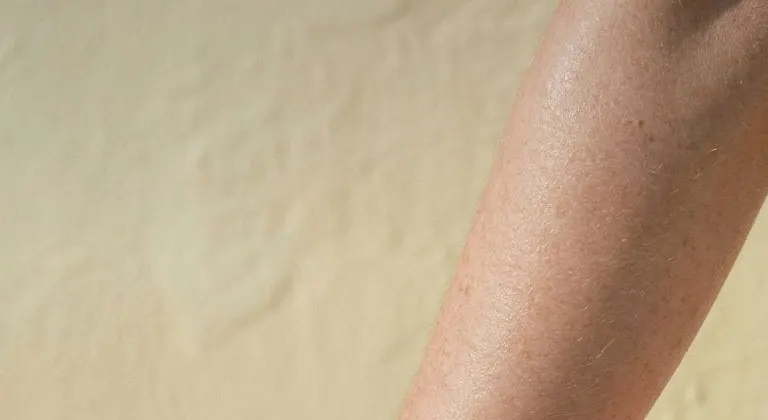
Age spots in your 30s are flat, pigmented marks (mostly solar lentigines) that surface as UV damage from earlier decades finally catches up with your skin. They are not a sign of accelerated aging and they are not dangerous. They are a record of every unprotected afternoon your skin has quietly been filing away since childhood.
You notice one while washing your face. A small brown patch where nothing used to be. You weren't expecting it at 32, or 35, or 37, and now the word "age" is doing a lot of work in your head.
Most new facial spots after 30 are completely benign. Knowing what you're looking at, which ones deserve a closer look, and what actually helps fade them saves you the 2 a.m. spiral and the useless purchases.
Key Takeaways
Why Am I Getting Dark Spots in My 30s?
The short answer: your 20s finally filed their paperwork. Solar lentigines (the technical name for sun spots) are driven by chronic UV exposure that increases melanocyte activity and epidermal melanin content in affected areas. Histology studies show solar lentigines have roughly double the melanocytes and double the melanin of nearby photoexposed skin 7.
They tend to appear on the high-sun real estate: cheeks, forehead, nose, temples, the back of the hands. Flat, brown, well defined, shaped like a freckle that showed up late. Your 30s are when cumulative damage crosses the visible threshold for most people, which is why the lentigo you're staring at today might trace back to a beach week in high school.
Hormones, genetics, and skin tone influence timing and intensity. If your mother has them, yours are probably on the way.
What Is the Difference Between Age Spots and Sun Spots?
They are the same thing. "Age spot," "sun spot," "liver spot," and "solar lentigo" all describe the same lesion: a flat, benign pigmented patch caused by UV exposure. The "age" label is misleading because these spots are photo-induced, not aging-induced. Plenty of 30-year-olds have them and plenty of 70-year-olds who wore sunscreen do not.
Where things get confusing is when people lump in two other common benign growths:
| Lesion | Texture | Color | Cause |
|---|---|---|---|
| Solar lentigo (age spot) | Flat, smooth | Tan to dark brown | Cumulative UV 7 |
| Seborrheic keratosis | Raised, waxy, "stuck on" | Tan, brown, or black | Benign epidermal growth, increases with age 8 |
| Post-inflammatory hyperpigmentation | Flat | Brown, red-brown, or gray | Pigment left after inflammation (acne, cut, irritation) |
Seborrheic keratoses are the most common benign skin tumor in humans and become extremely common with age, affecting up to 100% of people over 50 8. They look more dramatic than sun spots but carry no medical significance.
How Do I Fade Dark Spots on My Face?
You fade them with sunscreen, patience, and a short list of actives with real clinical backing. Topical treatments can lighten pigmentation meaningfully over 3 to 6 months, but they rarely erase it entirely, and they only work if you're also blocking new UV exposure.
The evidence-backed stack:
- Broad-spectrum SPF 30+, every morning. A 4.5-year randomized trial found daily sunscreen users showed 24% less skin aging than the discretionary-use group 1. No serum works if UV keeps topping up the pigment.
- Vitamin C (L-ascorbic acid, 10 to 20%). Topical vitamin C may help inhibit tyrosinase, the enzyme that drives melanin production. A systematic review supports its use for melasma and photoaging, usually as part of a combination regimen 2.
- Niacinamide (4 to 5%). Clinical studies show niacinamide reduces hyperpigmented spots by interfering with the transfer of melanosomes from melanocytes to surrounding skin cells 3.
- Azelaic acid (15 to 20%). Inhibits tyrosinase and is particularly well studied for post-inflammatory hyperpigmentation, with good tolerance in sensitive and rosacea-prone skin 4.
- Retinoids (tretinoin 0.025 to 0.05%, or retinaldehyde over the counter). A systematic review of tretinoin for photoaging found consistent improvement in mottled hyperpigmentation and lentigines, usually visible by month 3 to 6 5.
Actives layered haphazardly can cancel each other out or trigger irritation that causes more pigmentation. The Skin Bliss Smart Product Search lets you scan barcodes or paste ingredient lists to find formulas with clinically studied concentrations, so you're not guessing at percentages.
Can Sun Damage Appear Years Later?
Yes, and this is why SPF feels like a delayed-gratification investment. UV exposure causes long-lasting molecular changes in skin that continue driving pigmentation long after the tan fades. Research shows repetitive UV irradiation produces persistent shifts in gene expression and keratinocyte signaling that can keep melanocyte activity elevated for months 9.
Keratinocytes (the building-block cells of your epidermis) release signals like keratinocyte growth factor after UV stress, which prompts nearby melanocytes to produce more pigment. That feedback loop is one reason solar lentigines tend to stick around once they form 10.
Practically: the sun spot you see at 34 may be tied to exposure from 10 or 15 years ago. And the exposure you get this summer will show up somewhere down the line. Daily SPF is how you stop future spots from forming while you work on the existing ones. SPF isn't 100% protective, and you'll need to reapply every 2 hours during sustained outdoor exposure.
When Should a New Spot See a Dermatologist?
Most new pigmentation in your 30s is benign. But melanoma is real, and early detection changes outcomes, so a screening habit matters more than panic. Dermatologists use the ABCDE rule for self-checks 6:
- A, Asymmetry. One half of the spot does not mirror the other.
- B, Border. Edges are irregular, notched, or poorly defined.
- C, Color. Multiple shades of brown, black, red, blue, or white in one lesion.
- D, Diameter. Larger than about 6 mm (pencil eraser).
- E, Evolving. Any change in size, shape, color, texture, or new symptoms like itching or bleeding.
A spot that checks one box is worth a professional look. Most of the time it's nothing. Some early melanomas lack classic ABCDE features, so the "E" (evolving) criterion matters most. If something looks new, different, or is changing, book the appointment. The Skin Bliss Face Scanner gives you a dated baseline so you can compare a spot against your own history instead of relying on memory.
Frequently Asked Questions
How long do dark spots take to fade with topical treatment?
Expect 3 to 6 months of consistent use before you see meaningful fading, and sometimes longer for deep or older pigmentation 5. Post-inflammatory hyperpigmentation from a recent breakout typically fades faster than a solar lentigo that has been sitting on your cheek for years.
Do I need to see a dermatologist for every new spot?
No. Most new spots in your 30s are benign solar lentigines, seborrheic keratoses, or PIH. Screen using the ABCDE rule and book an appointment if a lesion is asymmetric, has irregular borders, contains multiple colors, exceeds 6 mm, or is changing 6.
Can I use vitamin C and retinol together for age spots?
Yes, with care. Many people use vitamin C in the morning and a retinoid at night to avoid stacking irritation. Both can cause sensitivity, so patch test on the inner arm first, introduce them one at a time, and always wear SPF during the day. If in doubt, run the combination through Skin Bliss Smart Product Search to check formulation compatibility.
Are professional treatments better than topicals for fading spots?
Chemical peels, IPL, and laser treatments can fade pigment faster than topicals but are not always necessary and carry their own recovery, cost, and risk of post-inflammatory hyperpigmentation, especially on medium to deep skin tones. For most benign spots, a consistent at-home routine with SPF and evidence-backed actives is enough.
Why are my dark spots more stubborn than my friend's?
Skin tone, genetics, hormones, and the age of the pigmentation all matter. Medium and deep skin tones produce more melanin during healing, so post-inflammatory pigmentation often lingers longer. Tranexamic acid is another clinically studied option your dermatologist can prescribe if topicals plateau.
New spots in your 30s are usually just your skin filing a receipt for the last 20 years of sunlight. Know the ABCDE rule, protect your face every morning, and give any active you try a full 12 weeks before you judge it. Save this guide for the next time a mystery mark sends you into a Google spiral, or open the Skin Bliss app to log it and track whether it changes.

In your browser
Free Skin Quiz: Understand your skin profile in under 5 minutes
Oily or dry is only the start. Find out what your skin actually needs across six skin dimensions, with a plain note on what each one means for your routine. Results appear in your browser, and you can keep them in the app.
Go deeper on Learn: Hyperpigmentation →

Maria combines her background in AI research with a passion for evidence-based skincare. She built Skin Bliss to help people make informed decisions about their skin, backed by science rather than marketing.
Sources (10)
- Hughes, M.C. et al. (2013). "Sunscreen and prevention of skin aging: a randomized trial." *Annals of Internal Medicine*.
- Sanadi, R.M., Deshmukh, R.S. (2020). "The effect of Vitamin C on melanin pigmentation: A systematic review." *Journal of Oral and Maxillofacial Pathology*.
- Hakozaki, T. et al. (2002). "The effect of niacinamide on reducing cutaneous pigmentation and suppression of melanosome transfer." *British Journal of Dermatology*.
- Kircik, L.H. (2011). "Efficacy and safety of azelaic acid (AzA) gel 15% in the treatment of post-inflammatory hyperpigmentation and acne: a 16-week, baseline-controlled study." *Journal of Drugs in Dermatology*.
- Riahi, R.R. et al. (2022). "Topical tretinoin for treating photoaging: A systematic review of randomized controlled trials." *Journal of Cosmetic Dermatology*.
- Abbasi, N.R. et al. (2004). "Early diagnosis of cutaneous melanoma: revisiting the ABCD criteria." *JAMA*.
- Bastiaens, M. et al. (2004). "Solar lentigines are strongly related to sun exposure in contrast to ephelides." *Pigment Cell Research*.
- Jackson, J.M. et al. (2015). "Current Understanding of Seborrheic Keratosis: Prevalence, Etiology, Clinical Presentation, Diagnosis, and Management." *Journal of Drugs in Dermatology*.
- Hermanns-Le, T. et al. (2008). "Long-lasting molecular changes in human skin after repetitive in situ UV irradiation." *Journal of Investigative Dermatology*.
- Chen, N. et al. (2009). "The role of keratinocyte growth factor in melanogenesis: a possible mechanism for the initiation of solar lentigines." *Experimental Dermatology*.