Journal · Routines & Protocols
How to choose a gentle cleanser for your skin type
How to choose a gentle cleanser by skin type, why pH and surfactants matter more than you think, and what a healthy barrier needs from your first step

Maria Otworowska, PhD, Co-founder of Skin Bliss
· 9 min read
A gentle cleanser is a face wash formulated to remove dirt, oil, and makeup without stripping your skin's protective barrier, the thin lipid layer that keeps moisture in and irritants out. Choosing the right one for your skin type is the single most underrated step in any routine, because harsh surfactants can damage skin proteins and lipids, leaving skin tight, dry, and irritated 1.
Key takeaways
Your cleanser's pH matters: neutral or slightly acidic formulas, close to your skin's normal pH of about 5.5, may be less damaging to the barrier 1Cream cleansers suit dry and normal skin; foaming gels work better for oily and acne-prone skin; sulfate-free, fragrance-free formulas are safest for sensitive skinOver-cleansing is a real risk: in a lab skin model, a harsh surfactant (sodium lauryl sulfate) made the skin barrier more permeable 3A ceramide-dominant cleanser and moisturizer regimen helped restore the skin barrier in adults with eczema 4Keep it short and gentle: thirty to sixty seconds of fingertip massage is plenty

Why does your cleanser matter more than you think?
Your skin's outermost layer, the stratum corneum, is held together by lipids that act like mortar between bricks. Every time you wash your face, surfactants in your cleanser interact with those lipids. Mild surfactants remove surface grime and leave the mortar intact. Harsh ones extract skin components and remain in the stratum corneum after rinsing, degrading its structure long after you've patted dry 2.
That degradation shows up as tightness, flaking, redness, or a weird greasy-yet-dry feeling your skin gets when it overproduces oil to compensate. A review in Dermatologic Therapy notes that milder surfactants, added lipids and humectants, and a neutral or acidic pH all help limit the damage a cleanser does 1. So the "cleanser doesn't matter, it's on your face for 30 seconds" crowd? They're wrong. Those 30 seconds set the stage for everything else.
What pH should your cleanser be?
Your skin's surface sits at roughly pH 4.5 to 5.5, slightly acidic. This acidity, called the acid mantle, helps fend off bacteria and maintain moisture levels. A cleanser close to this range may help support the acid mantle rather than working against it, and one review suggests cleansing products with a pH of 4.0 to 5.0 may be helpful 5.
Soap bars typically sit around pH 9 to 10. That alkaline hit neutralizes your acid mantle temporarily, and your skin can take hours to recover. A 2018 review in Current Problems in Dermatology notes that skin pH can take up to several hours to recover after washing, and that pH alone doesn't guarantee mildness: the mix of surfactants in the formula matters too 5.
Practical rule: if a cleanser leaves your skin squeaky, it's too alkaline or too stripping. Your face should feel clean, not tight.
Which cleanser type suits dry or normal skin?
Cream and lotion cleansers are your best match. These formulas use mild surfactants like cocamidopropyl betaine instead of sodium lauryl sulfate (SLS), and they typically include humectants like glycerin or hyaluronic acid that deposit moisture as they clean.
Ceramide-containing cleansers deserve special attention here. Ceramides are lipids that naturally occur in your barrier, and a randomized trial found that a daily regimen of ceramide-dominant cleanser and moisturizer restored skin permeability in adults with moderate eczema 4. That study was in eczema, but if your skin trends dry or reactive, ceramides in your cleanser may help replenish what washing takes away.
Look for labels that say "hydrating," "cream," or "milky." Skip anything that foams aggressively. And in the morning, you may not need a cleanser at all. A lukewarm water rinse can be enough to clear overnight sebum without stripping the oils your skin spent all night producing.
Which cleanser type suits oily or acne-prone skin?
Foaming gel cleansers give you the deeper clean oily skin needs without wrecking your barrier, provided they're well-formulated. The ingredient to look for is salicylic acid at 0.5 to 2%. It's a beta hydroxy acid (BHA) that's oil-soluble, so it can penetrate into pores and dissolve the sebum and dead cells that cause breakouts.
A 2025 study found that a 2% salicylic acid cleanser using polymeric cleansing technology reduced acne lesions starting at week four while maintaining the skin barrier 6. That last part matters. Older-generation acne cleansers often swapped one problem for another: clear pores but wrecked skin.
One caveat. If your skin is oily but also sensitive (this is more common than people realize), a salicylic acid cleanser might be too much for daily use. Try alternating it with a gentler formula: salicylic acid in the evening, plain gel cleanser in the morning. Your Skin Bliss Routine Builder can help you schedule this kind of alternating approach so you don't have to keep track yourself.
Which cleanser type suits sensitive skin?
Sensitive skin needs the shortest possible ingredient list. Every additional ingredient is another potential trigger. Look for sulfate-free, fragrance-free formulas, and read the actual ingredient list, because "fragrance-free" on the front label doesn't always mean zero fragrant compounds.
Soothing additions that earn their place: colloidal oatmeal, allantoin, panthenol, and niacinamide. These have demonstrated anti-inflammatory or barrier-supporting effects in clinical settings. Avoid "gentle" cleansers that still contain essential oils (lavender, tea tree, citrus). These are common sensitizers disguised as natural ingredients.
Cleansing time matters more for sensitive skin than any other type. Keep it to 30 seconds with lukewarm water. Warmer water may make surfactant irritation worse: in one small study, a surfactant solution caused more barrier damage and redness the warmer it was 8. Use your fingertips only. No washcloths, no brushes, no spinning devices.
How should you actually wash your face?
Technique gets overlooked, but it makes a genuine difference.
Water temperature: Lukewarm. Warmer water can amplify surfactant irritation 8; cold water doesn't dissolve oil-based impurities as effectively.
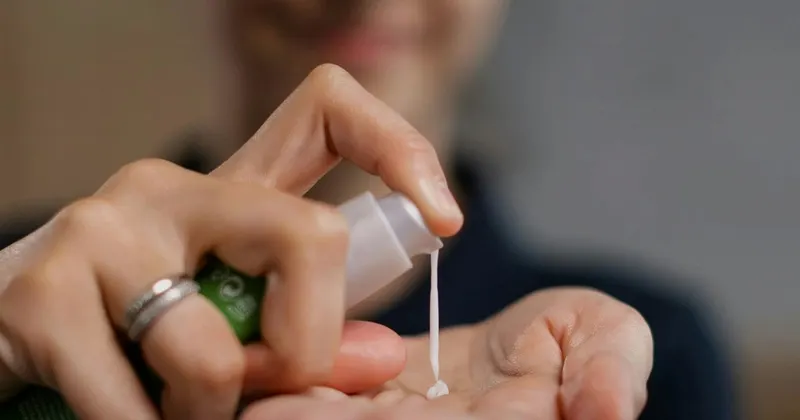
Amount: A pea-to-nickel-sized amount is enough. More product doesn't equal more clean.
Motion: Gentle circular movements with your fingertips. Thirty to sixty seconds of massage gives surfactants time to bind with impurities without over-exposing your skin.
Rinsing: Splash at least 10 to 15 times. Surfactant residue left on the skin continues to interact with your lipid barrier, which is why some people get irritation from cleansers that seem gentle on paper 2.
Drying: Pat with a clean towel. Rubbing creates friction that can irritate compromised or sensitive skin.
Do you need different cleansers for morning and evening?
Your skin faces different challenges at different times of day. In the morning, you're dealing with overnight sebum, maybe some residual product from the night before. For most skin types, water alone or a very mild cleanser handles this fine.
Evening is a different story. You need to remove sunscreen, makeup, environmental pollutants, and a full day's worth of oil. This is where your cleanser earns its keep. If you wear heavy sunscreen or makeup, you might benefit from double cleansing: an oil-based cleanser or micellar water first to dissolve oil-soluble stuff, then your regular cleanser to clear what's left.
Dermatologists take this step seriously too. A 2023 expert consensus on holistic skin care in the Journal of Cosmetic Dermatology puts cleansing, alongside moisturizing and sun protection, at the core of a routine for acne, rosacea, eczema, and sensitive skin 7.
Which cleanser is right for your skin type?
| Skin type | Cleanser format | Key ingredients to look for | Ingredients to avoid |
|---|---|---|---|
| Dry / normal | Cream or lotion | Ceramides, glycerin, hyaluronic acid | SLS, alcohol, strong fragrances |
| Oily / acne-prone | Foaming gel | Salicylic acid (0.5-2%), niacinamide | Heavy oils, coconut-derived comedogenic surfactants |
| Sensitive | Minimal-ingredient cream | Colloidal oatmeal, allantoin, panthenol | Fragrance, essential oils, sulfates |
| Combination | Gel or light foam | Glycerin, mild surfactants | Anything too stripping or too heavy |
FAQ
Can a cleanser cause breakouts?
Yes. Comedogenic ingredients in cleansers can clog pores, and over-stripping the barrier triggers rebound oil production that feeds acne. If you're breaking out along your jawline or cheeks after switching cleansers, the formula might be the problem. Give a new cleanser two weeks, then reassess.
Should you use the same cleanser year-round?
Not necessarily. Your skin produces less oil in winter and more in summer. Swapping to a creamier cleanser in cold months and a lighter gel in warm months tracks with what your skin actually needs. Pay attention to how your face feels after washing. That feedback is more useful than any schedule.
Is micellar water a replacement for a cleanser?
Micellar water works well as a first step for removing makeup and sunscreen, but it's not a complete substitute for a proper cleanser. Micelles (tiny oil molecules suspended in soft water) lift surface grime, but they don't provide the same level of cleansing as a rinse-off formula. Use it as step one of a double cleanse, not your only cleanse.
How do you know if your cleanser is too harsh?
Three signs: tightness within five minutes of washing, visible flaking that wasn't there before, or increased redness and sensitivity. If your skin feels like it "needs" moisturizer immediately after cleansing just to feel normal, your cleanser is stripping too much 1.
Can you use a body wash on your face?
No. Body washes are formulated for thicker body skin with higher surfactant concentrations. Facial skin is thinner, has more sebaceous glands, and is far more reactive. Use a product specifically formulated for the face.

In your browser
Free Skin Quiz: Understand your skin profile in under 5 minutes
Oily or dry is only the start. Find out what your skin actually needs across six skin dimensions, with a plain note on what each one means for your routine. Results appear in your browser, and you can keep them in the app.

Maria combines her background in AI research with a passion for evidence-based skincare. She built Skin Bliss to help people make informed decisions about their skin, backed by science rather than marketing.
Sources (8)
- Ananthapadmanabhan KP et al. (2004). "Cleansing without compromise: the impact of cleansers on the skin barrier and the technology of mild cleansing." *Dermatol Ther*.
- Walters RM et al. (2012). "Cleansing formulations that respect skin barrier integrity." *Dermatol Res Pract*.
- Hornby S et al. (2016). "Effect of commercial cleansers on skin barrier permeability." *Skin Res Technol*.
- Spada F et al. (2021). "A daily regimen of a ceramide-dominant moisturizing cream and cleanser restores the skin permeability barrier in adults with moderate eczema: A randomized trial." *Dermatol Ther*.
- Blaak J, Staib P (2018). "The Relation of pH and Skin Cleansing." *Curr Probl Dermatol*.
- Hussain R et al. (2025). "Novel 2% Salicylic Acid Cleanser With Polymeric Cleansing Technology Treats Acne Without Compromising Skin Barrier." *J Drugs Dermatol*.
- Goh CL et al. (2023). "Expert consensus on holistic skin care routine: Focus on acne, rosacea, atopic dermatitis, and sensitive skin syndrome." *J Cosmet Dermatol*.
- Berardesca E et al. (1995). "Effects of water temperature on surfactant-induced skin irritation." *Contact Dermatitis*.