Journal · Skin Concerns
Dehydrated but Oily: The Skin-Type Paradox, and How to Fix It
Your skin can be oily and dehydrated at the same time. Learn how to tell the difference and build a routine that actually helps.

Maria Otworowska, PhD, Co-founder of Skin Bliss
· 8 min read
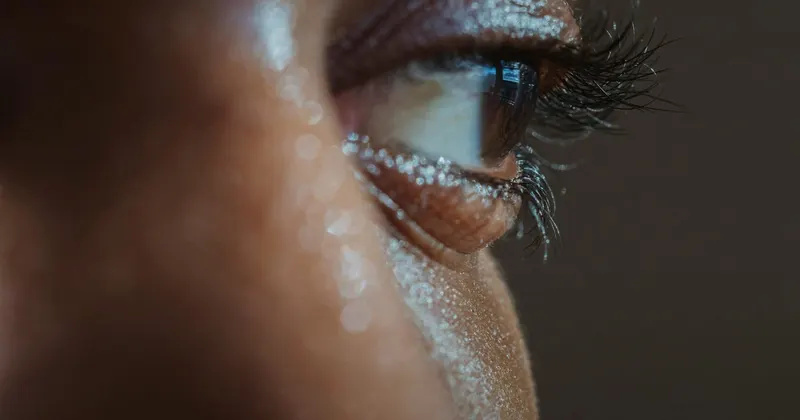
Your skin can be shiny and greasy by noon and still be dehydrated. Oiliness is a skin type controlled by sebum production; dehydration is a skin state determined by water content. These two exist on entirely separate axes, which means they can, and often do, happen at the same time.
What Is the Difference Between Oily Skin and Dehydrated Skin?
Oily skin is a skin type: your sebaceous glands produce more sebum than average. Sebum is a lipid-rich secretion that sits on the skin's surface and helps protect the epidermal barrier. Having oily skin is genetic and largely fixed.
Dehydration is a skin state, not a skin type. It refers to a lack of water in the stratum corneum (the outermost layer of the epidermis). Dehydrated skin shows up as tightness, rough texture, fine lines that appear when you smile or squint, and dullness. It can affect any skin type, including oily.
The two are often confused because dehydrated oily skin sends conflicting signals: it feels tight but looks shiny, flakes near the nose but has visible pores on the cheeks.
Can Oily Skin Really Be Dehydrated?
Yes. The sebum that makes your skin look oily lives on the surface, while water is stored within the stratum corneum itself. These are two physically separate systems.
Sebum plays a partial role in reducing transepidermal water loss (TEWL), the passive diffusion of water through the skin into the air. But sebum production is not the same as barrier integrity. The water in your skin is held there by the intercellular lipid matrix of the stratum corneum, built from ceramides, cholesterol, and free fatty acids. When those lipids are depleted, TEWL rises regardless of how much oil sits on the surface. Acne-prone skin shows both halves of that pattern: measured water loss runs higher than in controls 1, while stratum corneum ceramides and free fatty acids are reduced 2.
The result: skin that looks oily on the surface but is actively losing water underneath. This is the central paradox.
What Does the Research Show About Oily, Dehydrated Skin?
A 2024 cross-sectional study of 316 volunteers measured objective skin barrier parameters in acne patients compared to healthy controls 1. Acne patients, who tend to have higher sebum output, showed TEWL levels of 13.16 g/m²/day versus 10.63 g/m²/day in controls, a 24% increase (p < 0.001). Despite producing significantly more sebum, their skin was losing water at a higher rate.
The same study found that those already on acne treatment showed even higher TEWL, reflecting how many common acne ingredients (retinoids, benzoyl peroxide, salicylic acid at 2%) further disrupt the barrier while targeting sebum. Participants in the acne group who were not using moisturisers regularly showed measurably lower skin hydration values.
A 2023 expert review confirmed that in acne-affected skin, stratum corneum lipids are reduced, including ceramides and free fatty acids, even as sebaceous glands are larger and sebum excretion higher 2. More oil on top does not compensate for fewer lipids inside the barrier.
Why Does Over-Stripping Make Dehydration Worse?
This is where the cycle becomes self-reinforcing. When skin feels oily, the instinct is to cleanse more aggressively: foaming cleansers with high surfactant load, astringent toners, multiple exfoliation sessions per week. Each of these removes not just sebum but also the ceramides, cholesterol, and free fatty acids that hold the stratum corneum together.
Once those intercellular lipids drop, TEWL rises. The skin signals distress by ramping up sebum production further, attempting to re-seal the surface. The result is a feedback loop: more sebum, more stripping, more water loss, more oil.
This mechanism was described as early as 1990 in research by Berardesca and Maibach 3, who demonstrated that high TEWL and low stratum corneum water content occur together when barrier function is impaired, a pattern distinct from simply having dry skin.
Signs That the Barrier Loop Is Active
- Skin feels tight within 30 minutes of cleansing
- A moisturiser sits on top rather than sinking in
- Skin is shiny by midday but flaky near the nose and brows
- Active breakouts respond poorly to treatment
How to Tell If Your Oily Skin Is Dehydrated: A Diagnostic Table
| Signal | Points to oily skin | Points to dehydration |
|---|---|---|
| How does skin feel 30 min after washing? | Comfortable or slightly oily | Tight, uncomfortable |
| Does shine appear only on T-zone? | Yes (typical sebum distribution) | May be all-over |
| Do fine surface lines appear when you press your cheek? | Unlikely | Common |
| Does skin look dull despite feeling greasy? | No | Yes |
| Does moisturiser relieve tightness? | Barely, if at all | Yes, noticeably |
| Does skin feel rough-textured? | Not usually | Yes |
Two or more "dehydration" answers alongside an oily skin type is a strong signal that water content is the issue.
What Ingredients Help Dehydrated Oily Skin?
The goal is to restore water to the stratum corneum without adding occlusive heaviness that worsens oil production. A few ingredient categories work well here.
Humectants draw water into the stratum corneum from below (from the dermis) and from the air. Hyaluronic acid at 1-2% concentration is one of the most studied; glycerin at 5% performs comparably in a well-hydrated environment. Both are lightweight and non-comedogenic.
Barrier lipids replace what stripping removes. Ceramides at concentrations of 0.01-1% in formulation help reinforce the intercellular matrix and reduce TEWL. The Schachner et al. review explicitly recommends ceramide-containing cleansers and moisturisers as part of acne management for exactly this reason 2.
Niacinamide at 2-4% addresses both sides of the paradox. A placebo-controlled trial found that 2% niacinamide significantly lowered the rate of sebum excretion over four weeks 4, and a 12-week trial found that 4% reduced visible pore counts by week eight 5. It also supports ceramide synthesis.
Avoid alcohol-first toners, high-fragrance formulas, and physical exfoliants more than twice a week. Patch test new actives on your inner arm first, and apply daily SPF, as barrier-compromised skin is more sensitive to UV damage.
Use This in Your Routine
If you are not sure whether your oily skin is also dehydrated, the Skin Bliss Face Scanner can help identify the combination: it reads surface oil patterns alongside skin texture and hydration cues to build a full skin profile, then flags concern areas like barrier disruption or dehydration alongside acne risk.
Once you have a clearer picture of what your skin actually needs, the Routine Builder can map out a lightweight, hydration-first approach, sequencing your humectants, barrier lipids, and active ingredients so they support rather than cancel each other. Try it at skinbliss.app.
FAQ
Can oily skin be permanently dehydrated?
Dehydration is a state, not a permanent condition. With consistent use of barrier-supporting ingredients (ceramides, humectants) and a gentler cleansing routine, water levels in the stratum corneum can stabilise within 4-6 weeks. Sebum production may also normalise once the over-stripping cycle is broken.
Should I stop cleansing if my skin is dehydrated?
No. Cleansing is still necessary for oily skin. The switch to make is the type of cleanser: a low-surfactant, balanced-pH formula (ideally around pH 5.5) is far less likely to disrupt the barrier than a foaming soap-based wash. Twice daily cleansing is usually appropriate; more than that tends to accelerate TEWL.
Is a moisturiser necessary for oily skin?
Yes. The data from Sukanjanapong et al. showed that acne patients who used moisturisers regularly had lower TEWL and better skin hydration than those who did not, regardless of sebum output 1. The right moisturiser for oily skin is lightweight, water-based, and non-comedogenic, not a heavy cream.
Why does my skin look shiny but still feel tight?
Tightness after cleansing is one of the clearest signs of dehydration. Shininess is sebum. The two appearing together is the hallmark of oily dehydrated skin. The sebum layer sits on the surface while the stratum corneum beneath it is short on water.
Can active ingredients like retinoids make dehydration worse?
Yes. Retinoids increase cell turnover and can temporarily compromise barrier function, raising TEWL. The Sukanjanapong 2024 study found that acne patients on active treatment had the highest TEWL of all groups 1. If you are using retinoids, incorporating a ceramide-based moisturiser alongside them helps offset this effect. Start with a low concentration, increase gradually, and patch test before applying to your full face.

In your browser
Free Skin Quiz: Understand your skin profile in under 5 minutes
Oily or dry is only the start. Find out what your skin actually needs across six skin dimensions, with a plain note on what each one means for your routine. Results appear in your browser, and you can keep them in the app.

Maria combines her background in AI research with a passion for evidence-based skincare. She built Skin Bliss to help people make informed decisions about their skin, backed by science rather than marketing.
Sources (5)
- Sukanjanapong S, et al. "Skin Barrier Parameters in Acne Vulgaris versus Normal Controls: A Cross-Sectional Analytic Study."
- Schachner LA, et al. "Insights into acne and the skin barrier: Optimizing treatment regimens with ceramide-containing skincare."
- Berardesca E, Maibach HI. "Transepidermal water loss and skin surface hydration in the non invasive assessment of stratum corneum function."
- Draelos ZD, et al. "The effect of 2% niacinamide on facial sebum production."
- Chiu PC, et al. "The clinical anti-aging effects of topical kinetin and niacinamide in Asians: a randomized, double-blind, placebo-controlled, split-face comparative trial."