Journal · Routines & Protocols
How to Simplify Your Skincare Routine Without Losing Results
More products may not mean better skin. Learn how to simplify your routine to cleanser, moisturizer, sunscreen, and one active without losing results

Maria Otworowska, PhD, Co-founder of Skin Bliss
· 9 min read
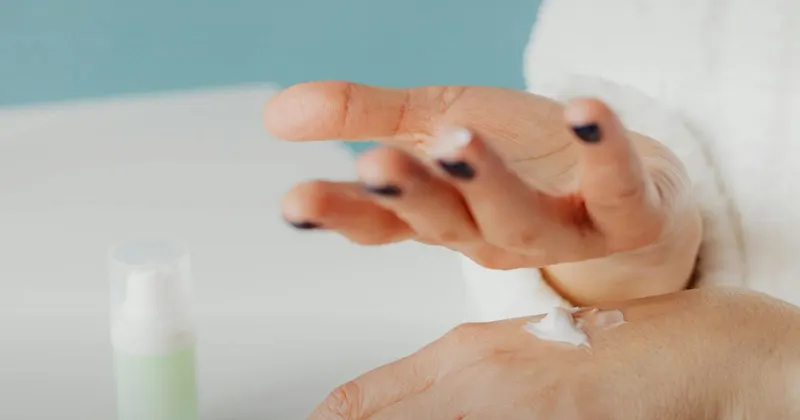
Simplifying your skincare routine means reducing the number of products you use to a core set of evidence-backed essentials, typically a gentle cleanser, a moisturizer, and a broad-spectrum sunscreen, then adding only the targeted actives your skin goals require, applied at concentrations and frequencies that your barrier can tolerate.
The fear of cutting products is real. You spent money on those serums. You read the reviews. But the evidence suggests that more products do not equal better skin. A randomized clinical trial found that a consistent regimen of just a cleanser and moisturizer produced significant improvements in both hydration and clinical dryness scores within two weeks 1. The gains came from consistency and compatibility, not from volume.

Key Takeaways
What are the essential steps in a simplified routine?
Dermatologists have reached consensus on the foundational steps: cleansing, moisturization, and photoprotection 2. These three actions address the biological basics. Cleansing removes sebum, dead cells, pollution, and product residue that can trigger inflammation. Moisturizing supplements the lipids and humectants that keep your barrier intact. Sunscreen prevents the UV damage that drives roughly 80% of visible facial aging.
A clinical trial comparing a mild cleanser and moisturizer regimen against no structured routine found statistically significant improvements in the treatment group for both clinical scores and dryness after just two weeks 1. That is the baseline. Everything else you add on top of it is an enhancement, not a necessity. The distinction matters because it flips the mental model from "what am I missing?" to "what specifically does my skin need beyond the basics?"
If you have a specific concern like hyperpigmentation, acne, or fine lines, you add one targeted active. One. Not four.
How do you decide which products to cut?
Start by listing every product in your current routine and its purpose. Then ask: does this product serve a function that nothing else in my routine covers? You will likely find significant overlap. Three products with hyaluronic acid in them. Two with niacinamide. A moisturizer and a separate serum both delivering ceramides.
| Product type | Keep if | Cut if |
|---|---|---|
| Gentle cleanser | You use it daily and it does not leave skin tight | You have two cleansers for morning and evening with no clear reason |
| Moisturizer | Contains ceramides, humectants, or occlusives suited to your skin type | You use multiple moisturizers layered on top of each other |
| Sunscreen (SPF 30+) | Broad-spectrum, applied daily | You rely on SPF in makeup only, which is typically under-applied |
| Treatment serum | Addresses a specific concern at an effective concentration | You have three serums and are not sure which one does what |
| Exfoliant (AHA/BHA) | Used 2-3 times per week for texture or congestion | You use it daily alongside a retinoid |
| Retinoid | Addresses aging, acne, or texture as your primary active | You layer it with other strong actives nightly and experience irritation |
Skin Bliss's Shelf Analysis feature can help here. Snap a photo of your products and it analyzes every one, flagging ingredient overlap and potential clashes. The Routine Evaluator then tells you whether your remaining products actually support your goals.
Can one active ingredient replace several products?
Yes, if you choose the right one. Niacinamide is the strongest example. This single ingredient has clinical evidence for reducing wrinkles and hyperpigmented spots, improving skin texture, decreasing redness, and strengthening the barrier by boosting ceramide production 4. A clinical trial showed significant improvements across all of those endpoints compared to a control 6. That is five outcomes from one ingredient at concentrations as low as 2-5%.
Vitamin C is another multitasker. It stimulates collagen synthesis, provides antioxidant protection against UV-generated free radicals, and helps fade hyperpigmentation 7. When paired with vitamin E, the photoprotective effect increases roughly fourfold 8. So a single serum containing both vitamins can replace a separate antioxidant, a brightening product, and part of your anti-aging strategy.
Bakuchiol deserves mention too. A double-blind randomized trial found it comparable to retinol for improving photoaging, including wrinkles, pigmentation, and elasticity, but with significantly less irritation 9. If retinol is one of the products making your routine complex (because you need extra moisturizer and barrier support to tolerate it), bakuchiol might give you similar results with a simpler supporting cast.
If you use any retinoid, AHA, BHA, or vitamin C, patch test on your inner arm first. These actives can cause irritation, especially when you are rebuilding your routine. Wear SPF daily when using retinoids or exfoliating acids, and reapply every two hours during extended sun exposure.
What is the right order for a minimal routine?
Order matters because it affects absorption. The general rule is thinnest to thickest consistency, with water-based products before oil-based ones. For a simplified routine, this is straightforward.
Morning:
- Gentle cleanser (or water rinse if your skin is dry)
- Treatment serum if using one (vitamin C works best in the morning for its antioxidant photoprotective effect 7)
- Moisturizer
- Sunscreen (SPF 30+, applied as the last skincare step before makeup)
Evening:
- Gentle cleanser (double cleanse with an oil-based cleanser first if you wear makeup or sunscreen)
- Treatment active if using one (retinoids and AHAs work best at night because UV exposure degrades them)
- Moisturizer (a ceramide-containing formula supports overnight barrier repair 10)
That is five to six products total, with only one or two treatment actives. Compare that to a 10-step routine and consider: what were those extra five products actually doing that this does not cover?
How long should you wait before judging your simplified routine?
Four to six weeks. This is not arbitrary. Your epidermis completely renews itself in roughly that timeframe, with new keratinocytes forming at the basal layer and migrating to the surface where they become the stratum corneum 5. Any change to your routine needs at least one full turnover cycle to show its real effect.
During the first week, you may experience a brief adjustment period. If your skin was accustomed to daily exfoliation, it might feel slightly rougher as it recalibrates its natural turnover rate. This is normal and temporary. If you experience burning, persistent redness, or worsening breakouts beyond two weeks, something in your reduced routine is not compatible with your skin. Swap one product at a time until you identify the trigger.
Track your skin during this period. Skin Bliss's Skin Diary lets you log daily observations, symptoms, and triggers. The AI Photo Comparison feature can detect subtle changes over weeks that you might miss in the mirror. Objective tracking removes the guesswork from evaluating whether your simplified routine is delivering.
Frequently asked questions
Will my skin get worse if I stop using actives?
Not if you maintain the core routine of cleansing, moisturizing, and sun protection. Your skin will adjust. Any temporary roughness from dropping an exfoliant typically resolves within two to three weeks as your natural cell turnover normalizes. The barrier improvements from consistent moisturizing and sun protection compound over time 1.
Do I need a toner in a simplified routine?
For most people, no. Toners were originally designed to remove soap residue and rebalance skin pH, but modern gentle cleansers already do this. If your toner contains an active ingredient like niacinamide or hyaluronic acid that you value, you can keep it. But a separate toner step is rarely necessary and is one of the easiest products to cut without losing results.
Is double cleansing necessary?
Only if you wear makeup, heavy sunscreen, or live in a high-pollution environment. An oil-based first cleanse dissolves oil-soluble residues that water-based cleansers miss. If you wear minimal makeup and a light sunscreen, a single gentle cleanse is sufficient. Over-cleansing can strip the skin barrier, which is the opposite of what a simplified routine aims to achieve 2.
Can I simplify if I have acne-prone skin?
Yes. A gentle cleanser, a non-comedogenic moisturizer, and sunscreen form your base. For acne specifically, one targeted active like a BHA (salicylic acid) at 1-2% used two to three times per week is often enough for mild to moderate congestion. Adding a separate acne wash, acne toner, acne serum, and acne spot treatment simultaneously is a common overcorrection that leads to barrier damage and more breakouts 3.
How do I know if my simplified routine is working?
Look for reduced sensitivity (products no longer sting), improved hydration (skin feels comfortable without reapplying moisturizer constantly), and stable texture (fewer random breakouts). These changes typically appear within two to four weeks. For concerns like hyperpigmentation or fine lines that involve deeper skin remodeling, expect six to twelve weeks before visible improvement 5.

In your browser
Free Skin Quiz: Understand your skin profile in under 5 minutes
Oily or dry is only the start. Find out what your skin actually needs across six skin dimensions, with a plain note on what each one means for your routine. Results appear in your browser, and you can keep them in the app.

Maria combines her background in AI research with a passion for evidence-based skincare. She built Skin Bliss to help people make informed decisions about their skin, backed by science rather than marketing.
Sources (10)
- Blakely KM et al. (2020). "A consistent skin care regimen leads to objective and subjective improvements in dry human skin: investigator-blinded randomized clinical trial." *J Cosmet Dermatol*.
- Lyons AB et al. (2022). "Expert consensus on holistic skin care routine: Focus on acne, rosacea, atopic dermatitis, and sensitive skin syndrome." *J Cosmet Dermatol*.
- Pal S et al. (2024). "Assessing the Adverse Effects and Safety Concerns Related to Cosmetic and Skincare Products: A Systematic Review." *Cureus*.
- Boo YC. (2024). "Mechanistic Insights into the Multiple Functions of Niacinamide: Therapeutic Implications and Cosmeceutical Applications in Functional Skincare Products." *Antioxidants*.
- Alexander H et al. (2018). "Research Techniques Made Simple: Transepidermal Water Loss Measurement as a Research Tool." *J Invest Dermatol*.
- Bissett DL et al. (2005). "Niacinamide: A B vitamin that improves aging facial skin appearance." *Dermatol Surg*.
- Al-Niaimi F, Chiang NYZ. (2017). "Topical Vitamin C and the Skin: Mechanisms of Action and Clinical Applications." *J Clin Aesthet Dermatol*.
- Lin JY et al. (2003). "UV photoprotection by combination topical antioxidants vitamin C and vitamin E." *J Am Acad Dermatol*.
- Dhaliwal S et al. (2019). "Prospective, randomized, double-blind assessment of topical bakuchiol and retinol for facial photoageing." *Br J Dermatol*.
- Chamlin SL et al. (2002). "Ceramide-dominant barrier repair lipids alleviate childhood atopic dermatitis: changes in barrier function provide a sensitive indicator of disease activity." *J Am Acad Dermatol*.