Journal · Skin Concerns
Cystic Acne: What to Try When OTC Stops Working, Before Accutane
If OTC products are not clearing your cystic acne, there is a clear prescription escalation path before isotretinoin. Here is what dermatologists try first.

Maria Otworowska, PhD, Co-founder of Skin Bliss
· 8 min read
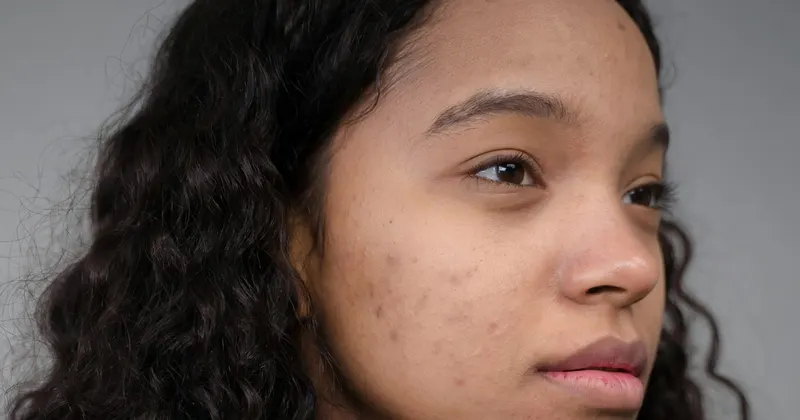
If benzoyl peroxide and salicylic acid have not cleared your cystic or nodular acne after 12 weeks of consistent use, prescription options exist between drugstore products and oral isotretinoin. A dermatologist can guide you through topical retinoids, oral antibiotics, and hormonal therapies before isotretinoin becomes the conversation.
Medical disclaimer: This article is educational, not medical advice. Prescription treatments and oral isotretinoin must be guided by a licensed dermatologist. Do not self-prescribe or adjust prescription dosing.
What Makes Cystic Acne Different From Regular Breakouts?
Cystic acne involves deep, inflamed nodules and cysts that form when a hair follicle becomes blocked and the resulting inflammation spreads into surrounding tissue. Unlike surface whiteheads or blackheads, cysts sit too deep for topical OTC actives to reach effectively.
The key consequence: untreated inflammatory lesions are the primary driver of permanent scarring. This is why escalating to prescription care matters, not just for clearing skin today but for protecting skin structure long-term. The 2024 American Academy of Dermatology (AAD) guidelines recommend isotretinoin specifically for acne that is "severe, causing psychosocial burden or scarring, or failing standard oral or topical therapy" 1. That framing is useful: the ladder below is what "standard therapy" means in practice.
How Long Should You Actually Give OTC Products?
A fair trial is 10-12 weeks of twice-daily 2.5% or 5% benzoyl peroxide, a topical retinoid (adapalene 0.1% is OTC in many countries), and a consistent gentle routine. If cysts and nodules are still appearing at that point, the formulation, concentration, or mechanism you need is beyond what OTC can provide.
The 2024 AAD guidelines give strong recommendations for benzoyl peroxide and topical retinoids as first-line agents for most acne 1. Strong recommendations from that same guideline also cover prescription-strength tretinoin and oral doxycycline, which is why the step up to prescription care is evidence-backed, not a shortcut.
The Prescription Escalation Ladder
Use this as a reference, not a self-treatment guide. A dermatologist will choose based on acne type, severity, your hormonal profile, and medication history.
| Step | Option | Who it fits | Typical timeline |
|---|---|---|---|
| 1 | Prescription-strength tretinoin (0.025%–0.1%) | Most types | 12–16 weeks |
| 2 | Oral doxycycline (50–100 mg) + topical combo | Moderate-severe inflammatory | 12 weeks; limit antibiotic duration |
| 3 | Spironolactone (off-label, women) | Hormonal pattern, jaw/chin cysts | 3–6 months |
| 4 | Clascoterone 1% cream (topical anti-androgen) | Any sex, 12+ years, hormonal-type | 12 weeks |
| 5 | Oral isotretinoin | Severe, scarring, or unresponsive | 4–6 months course |
The AAD 2024 guidelines give conditional recommendations for spironolactone and clascoterone, and a strong recommendation for oral antibiotics combined with topical therapy 1.
Prescription Topical Retinoids: What They Add
Tretinoin, tazarotene, and trifarotene work the same receptor pathway as OTC adapalene but at higher concentrations and with slightly different receptor selectivity. Tretinoin at 0.05% increases cell turnover roughly 2× compared with adapalene 0.1% in head-to-head studies, which matters for follicles prone to deep blockages.
Expect a purging window of 4-8 weeks when starting. This is not the treatment failing. New cysts that form during purging are accelerated clearance of follicles that were already blocked. Ask your dermatologist about a low-and-slow introduction: applying every third night for two weeks, then every other night, before moving to nightly use.
Antibiotic Combinations: The Time-Limit Rule
Oral doxycycline is often paired with a topical retinoid and benzoyl peroxide. The benzoyl peroxide component is not cosmetic: it actively reduces antibiotic-resistant C. acnes populations. The AAD guidelines recommend limiting systemic antibiotic courses and always combining them with non-antibiotic topicals for this reason 1.
Hormonal Options: Spironolactone and Clascoterone
If your cysts follow a hormonal pattern (flares around your cycle, concentrated on the jaw, chin, or neck) then anti-androgen therapy can address acne at the root cause rather than managing the inflammation after the fact.
Spironolactone (off-label, women only) blocks androgen receptors in sebaceous glands, reducing sebum output. A 2025 review by Smith CA et al. at Emory University School of Medicine confirmed clinical trial data supporting its use as a first-line treatment for women with acne, and noted that routine potassium monitoring is low-value unless specific hyperkalemia risk factors are present 2.
Clascoterone 1% cream is a topical anti-androgen approved for ages 12 and up of any sex. Because it acts locally, it does not carry the systemic hormonal effects of oral anti-androgens. A 2023 review in Drugs of Today describes it as "safe and effective for female and male patients" based on phase III clinical data 3. It is a meaningful option for people who cannot take or prefer to avoid oral systemic treatments.
When Does Isotretinoin Become the Reasonable Next Step?
Oral isotretinoin (commonly known by the brand name Accutane) is the only treatment that targets all four pathogenic factors in acne: sebum production, follicular hyperkeratinization, C. acnes colonization, and inflammation. No other agent addresses all four simultaneously.
A 2017 systematic review of 11 randomized controlled trials in the British Journal of Dermatology confirmed that isotretinoin reduced acne lesion counts by a clinically relevant margin, always outperforming controls including oral antibiotics 4. Adverse events occurred at 2× the frequency of controls, with the most common being dryness-related, and more serious events were rare but real. This is why dermatologist oversight is not optional: the risk-benefit decision requires a full medical history, and iPLEDGE (or equivalent) registration in countries where it is required.
Isotretinoin Is Typically Considered When:
- Severe nodular or cystic acne covering large areas of the face, chest, or back
- Two or more adequate antibiotic courses have not produced lasting clearance
- Scarring is present or actively forming
- Acne is causing significant psychological distress
- Hormonal treatment has failed or is not an option
A low-dose isotretinoin protocol (0.1-0.3 mg/kg/day) may be appropriate for some patients as an alternative to the standard 0.5-1 mg/kg/day course, with a 2020 systematic review in Dermatologic Therapy noting comparable end-results with fewer side effects 5. Your dermatologist will decide dosing; this is not a figure to self-calculate.
Use This in Your Routine
Working out which prescription step you are at, or whether your current OTC routine has had a real trial, is something the Skin Bliss Routine Builder can help clarify. Build your current routine step-by-step, and the Routine Builder will flag whether your actives (benzoyl peroxide concentration, retinoid type, timing) are configured for cystic acne or just surface breakouts.
If you are about to see a dermatologist, having a documented routine ready to show them speeds the consultation. Start at skinbliss.app.
FAQ
How long should I try OTC products before seeing a dermatologist?
A reasonable trial is 10-12 weeks of consistent daily use. For cystic or nodular acne specifically, dermatologists often recommend booking a consultation sooner, because deep cysts carry a higher scarring risk than surface breakouts, and waiting extends that risk window.
Can I take doxycycline long-term to manage cystic acne?
Oral antibiotics are not intended as a long-term maintenance treatment. The AAD guidelines recommend limiting antibiotic courses and always pairing them with topical benzoyl peroxide to reduce antibiotic resistance. After a course clears the bacterial load, the plan typically shifts to maintenance with topical retinoids and benzoyl peroxide.
Is spironolactone only for women with hormonal acne?
Spironolactone is prescribed off-label for women with acne, and the evidence supports it particularly for those with a hormonal pattern. It is not used in men due to anti-androgenic systemic effects. For male patients with a hormonal-type acne pattern, clascoterone cream is the topical alternative with limited systemic effects.
What happens if I stop isotretinoin halfway through a course?
Incomplete courses increase the chance of relapse. The standard total cumulative dose of 120-140 mg/kg is associated with the lowest recurrence rates. Stopping early due to side effects should be done with your dermatologist, who can adjust dose or pause temporarily rather than discontinuing entirely.
Does isotretinoin cause depression?
The relationship between isotretinoin and mood is an active area of research and clinical monitoring. The 2017 British Journal of Dermatology systematic review listed depressed mood among adverse events that caused participant withdrawal in trials 4. Dermatologists routinely screen for mood changes during a course. If you have a history of depression or anxiety, discuss it explicitly before starting.

In your browser
Free Skin Quiz: Understand your skin profile in under 5 minutes
Oily or dry is only the start. Find out what your skin actually needs across six skin dimensions, with a plain note on what each one means for your routine. Results appear in your browser, and you can keep them in the app.

Maria combines her background in AI research with a passion for evidence-based skincare. She built Skin Bliss to help people make informed decisions about their skin, backed by science rather than marketing.
Sources (5)
- Reynolds RV, Yeung H, et al. "Guidelines of care for the management of acne vulgaris."
- Smith CA, Gosnell E, et al. "Hormonal Therapies for Acne: A Comprehensive Update for Dermatologists."
- Manjaly C, Martinez J, et al. "Clascoterone for treatment of acne."
- Vallerand IA, Lewinson RT, et al. "Efficacy and adverse events of oral isotretinoin for acne: a systematic review."
- Sadeghzadeh-Bazargan A, Ghassemi M, et al. "Systematic review of low-dose isotretinoin for treatment of acne vulgaris."