
What's your skin type? Find out before you buy another product.
Oily or dry is only the start. Two people with oily skin may need very different routines, because one is sensitive and the other breaks out. The quiz reads your skin type plus five other dimensions, so you know what to look for before your next buy. No prior skincare knowledge needed: every question is about something you already notice.




- 3.2Mquizzes taken
- 84%of users satisfied
- 21+easy questions
Know why your skin does what it does
Your skin type, plus five more skin dimensions: sensitivity, elasticity, acne, tone and texture. As you finish each one, the quiz gives you a note in plain language on what your result means for your routine. A few examples below.







Gathers in patches
Color sits unevenly across the cheeks, the starting point for a tone-focused routine.
Mostly smooth
Smooth most days with the odd rough patch, so a mild exfoliant once a week is plenty.
Calm, slow to react
A strong barrier holds on to its water, so the routine only has to keep it hydrated.
A skincare routine where every step has a job
The quiz shows which of these goals fit your skin. The Skin Bliss app then builds a routine around them.
Calmer, less reactive skin
Stinging or flushing after new products. The routine sticks to gentle steps and brings in actives one at a time.


A more even-looking tone
Dark marks that stay long after a breakout or a summer. The routine pairs a brightening serum with daily SPF.
Smoother texture
Rough patches that make-up catches on. The routine adds an exfoliating toner and a retinol at night, with a moisturizer to keep skin comfortable.


Fewer breakouts
Clogged pores and spots that keep coming back. The routine keeps pores clear with a gentle cleanser, toner and serum, without stripping the skin.

Five minutes to stop guessing about your skin
Answer 21+ easy questions and see your skin type, plus five more skin dimensions, in your browser.
Find my skin typeFreeStart without an account or email
Stop treating your skin for the wrong problem
The most common skincare myths our users come to the app with, and how each one usually plays out.

The skincare scanner that knows your skin
Skin Bliss is a mobile skincare app for iOS and Android, built in the EU and downloaded more than 3 million times. It reads your skin and checks products against what it finds, then builds a routine you can follow and adjust as things change.
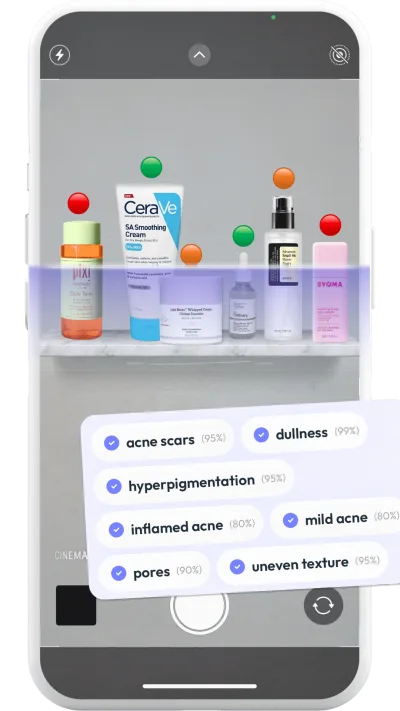
This quiz is the web version of the first step. It gives you a skin profile in under five minutes, in your browser. The app is where that profile becomes something you use every day: it checks the ingredients in the products you already own against your profile and builds a routine around it.
The app is free on iOS and Android. Sign in with the same account and the profile you build here is already there, with no quiz to redo. Skin Bliss Pro, an optional upgrade, adds the face scanner and the deeper tools.


Founded by Dr. Maria Otworowska and Dr. Marvin Uhlmann. How the app scores products
Everything you want to know before the skin type quiz
A free skin type test: 21 to 27 questions about your skin. You start without an account, and a free account saves your skin profile to the Skin Bliss app.
How do I know what my skin type is?
Watch how your skin behaves without products on it: how shiny it gets through the day, whether it feels tight after rinsing, and how it changes between summer and winter. The quiz asks exactly those questions and turns your answers into a skin type. If you would rather check at home, the bare-face and tissue tests work too.
How to find your skin type at homeWhat are the four skin types?
Oily, combination, normal (balanced) and dry. They differ in how much oil your skin makes and where: oily skin makes more than average and shines all over, combination skin shines mainly in the T-zone, normal skin makes a moderate, even amount, and dry skin makes less than average. Sensitivity is not one of the four: the quiz reads it separately, because skin of any type can be reactive.
What are the six skin dimensions?
Oil balance, which sets your skin type: how much oil your skin makes and where. Sensitivity: how readily it reacts to products, scent and washing. Elasticity: how firm it is and where lines show. Acne: how prone it is to blackheads and breakouts. Tone: how even your color is, including dark marks, sun darkening and under-eye circles; this part also asks how light or deep your skin is. Texture: how smooth it looks and feels, and how foundation sits on it.
What do I get at the end of the quiz?
Your skin profile. It tells you whether your skin is oily, combination, normal or dry and gives your result on five more skin dimensions: sensitivity, elasticity, acne, tone and texture. It also lists any skin concerns your answers point to, with tips, and each dimension gets a note in plain language as you finish it. A free account saves the profile to the Skin Bliss app, which builds your routine around it.
How long does the skin type quiz take?
Under five minutes. It asks 21 to 27 questions about your skin across six skin dimensions: oil balance, sensitivity, elasticity, acne, tone and texture. It asks more about a dimension only when your first answers there are mixed or unsure.
Is 5 minutes enough to judge my skin profile?
Yes. Every question is about something you already notice, like how your skin feels an hour after rinsing, so there is nothing to look up. When you know an answer, it tells the quiz about your skin. When you don't, that tells it something too: the quiz asks more about that dimension, and if most of your oil-balance answers are unsure, it leaves your skin type unsettled instead of guessing.
Is the skin type quiz free?
Yes. The quiz is free, and so is the Skin Bliss app on iOS and Android. Skin Bliss Pro is an optional upgrade inside the app.
Do I need an account to take the quiz?
No. You answer every question without one. A free account is what saves your skin profile and opens it in the Skin Bliss app, with no quiz to redo.
Do I need to know anything about skincare to take the quiz?
No. Every question is about something you can see in the mirror or remember from an ordinary day, like whether you wake up with a shiny face or how your skin feels an hour after rinsing with water. You won't need to know any ingredients, and the few skincare words it uses, like T-zone, are explained on the spot.
How does the quiz work out my skin type?
Only from your answers. For oil balance it asks whether you wake up shiny, how tight your skin feels an hour after rinsing with water, and how it changes with the seasons. If those first answers are mixed or unsure, it asks two more: how your skin would look in a close-up photo on a sunny day, and how foundation wears over a few hours.
How accurate is a skin type quiz?
The quiz works from how you describe your skin, so it is as accurate as your answers. It asks about things you can check, like whether your skin feels tight an hour after rinsing, and asks more when your first answers are mixed or unsure. If most of your oil-balance answers are ones like "I'm not sure", it leaves your skin type unsettled instead of guessing and lets you answer again. It uses the same questions and scoring as the Skin Bliss app. The face scanner in Skin Bliss Pro reads your skin from a photo instead.
How is this different from a skincare brand's quiz?
It comes from Skin Bliss, the company behind the Skin Bliss app, and brands cannot pay for placement or a better score in Skin Bliss: its revenue comes from app subscriptions. It also looks past skin type, to five more skin dimensions that change what works on your skin.
Who made this quiz?
The Skin Bliss team. Skin Bliss SIA builds the Skin Bliss app for iOS and Android in the EU, and its founders are two scientists: Dr. Maria Otworowska and Dr. Marvin Uhlmann. The quiz uses the same questions and scoring the app uses to set up your skin profile.
Can my skin type change?
Yes. How much oil your skin makes shifts with age, hormones, pregnancy, medication and climate, and it tends to drop over the years. If your skin starts acting differently, it is worth taking the quiz again.
Can this quiz replace seeing a dermatologist?
No. It is a self-assessment, not a diagnosis, and it is not medical advice. If a skin problem is painful, spreading, bleeding or not getting better, see a dermatologist or a doctor.
Start with what your skin is actually doing
For anyone with a shelf of products that did nothing.
Start free quizFreeStart without an accountUnder 5 minutes