Journal · Skin Barrier & Recovery
6 Skincare Ingredients That Damage Your Skin Microbiome
Six common skincare ingredients may reduce microbial diversity and disrupt your skin barrier. Learn what to swap and which gentler alternatives to reach for

Maria Otworowska, PhD, Co-founder of Skin Bliss
· 11 min read
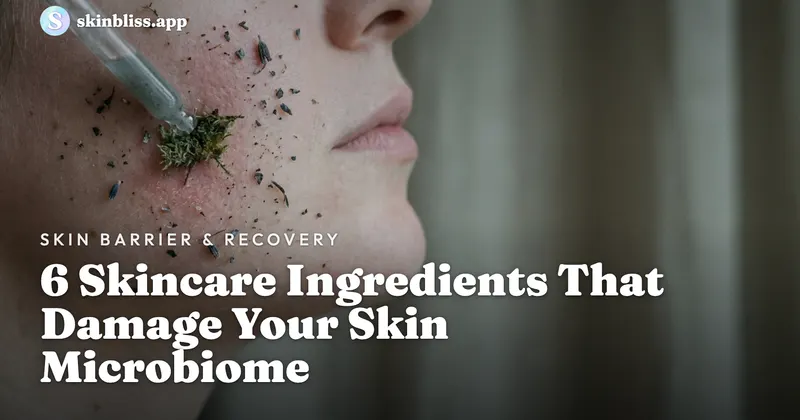
Your skin microbiome is the community of bacteria, fungi, and other microorganisms that live on the skin surface and play a direct role in barrier function, immune regulation, and protection against pathogens, and certain common skincare ingredients can reduce this microbial diversity, shift the balance toward harmful species, and compromise the skin's ability to defend itself.
About a trillion microorganisms call your skin home. When the community is diverse and balanced, your skin stays calm, hydrated, and resilient. When it is disrupted, you get inflammation, sensitivity, breakouts, and a barrier that cannot hold itself together. The source of disruption is often sitting on your bathroom shelf.
Key Takeaways
Why does your skin microbiome need protection?
Your skin microbiome is not passive. It is an active defense system. Beneficial bacteria like Staphylococcus epidermidis produce antimicrobial peptides that fight pathogens. They help regulate local immune responses. They produce metabolites that directly contribute to barrier repair 5.
When researchers measure microbiome health, they use something called the Shannon diversity index. Think of it like a biodiversity score for your skin. Healthy skin scores above 3.0. Disrupted skin, like skin affected by eczema or chronic irritation, scores significantly lower 6. The higher your diversity, the more resilient your skin is against environmental stress, infections, and inflammatory flares.
The six ingredients below are not inherently evil. Context matters: concentration, frequency, formulation, and your individual skin all play a role. But each of these has documented evidence of disrupting microbial communities on the skin surface, and for most people, safer alternatives exist.
1. Sodium lauryl sulfate (SLS): is it really that bad?
SLS is a surfactant, which means it is the ingredient in your cleanser that makes it foam and dissolve oil. It is very effective at cleaning. It is also very effective at stripping away the lipid barrier and the bacteria living in it.
Research shows that SLS-based cleansers significantly reduce the alpha diversity of skin bacteria after just three weeks of use 1. The prokaryotic microbial community, meaning the bacteria, showed a measurable decline. SLS also depletes ceramides from the stratum corneum, which is the structural damage that creates habitat loss for beneficial microbes.
The shift is not random. SLS exposure tends to increase populations of Acinetobacter and Escherichia-Shigella while disrupting the balance of commensal species that were keeping the peace 1. This is the microbiome equivalent of clear-cutting a forest and watching invasive species move in.
Use instead: Cleansers made with amino acid surfactants (sodium cocoyl glutamate, sodium lauroyl methyl isethionate) or gentle glucosides. They clean effectively without the scorched-earth approach. Look for a cleanser pH of 4.5-5.5. The Skin Bliss Ingredient Compatibility Checker can flag SLS and other harsh surfactants in your current products.
2. Denatured alcohol (SD alcohol, alcohol denat.): how much is too much?
Denatured alcohol shows up in toners, serums, and sunscreens. In small amounts (under 5%), it helps products dry quickly and can improve the feel on oily skin. The problems start at higher concentrations.
Research indicates that ethanol concentrations above 15% negatively affect barrier integrity, increasing stratum corneum permeability and trans-epidermal water loss 2. At those concentrations, alcohol dissolves the lipid "mortar" between skin cells. It is a solvent doing solvent things. The antimicrobial effect is nonselective: it kills beneficial bacteria along with everything else 7.
Not all alcohol in skincare is a problem. Fatty alcohols like cetyl alcohol and cetearyl alcohol are not solvents. They are emollients that actually support the barrier. The issue is specifically with short-chain volatile alcohols (ethanol, denatured alcohol, isopropyl alcohol) at high concentrations.
Use instead: If your product uses alcohol as a penetration enhancer or quick-dry agent, look for formulations that use propanediol or lightweight silicones instead. For toners, switch to alcohol-free options with hydrating ingredients like hyaluronic acid or beta-glucan.
3. Triclosan and antibacterial agents: why were they ever in skincare?
Triclosan is a broad-spectrum antimicrobial that was once common in hand soaps, body washes, and even some facial cleansers. It has been banned from consumer hand soaps in the United States since 2016, but it still appears in some cosmetic and personal care products globally.
The evidence against triclosan for skin health is substantial. Animal studies show it alters both alpha and beta diversity of the skin microbiome, increasing certain bacterial families while decreasing others 8. It also increases trans-epidermal water loss, meaning it damages the physical barrier as well 8. Perhaps most concerning, triclosan exposure has been linked to the development of antimicrobial resistance, where bacteria evolve to survive not just triclosan but potentially other antimicrobials too 9.
Use instead: For antibacterial needs, products containing low-concentration benzoyl peroxide (2.5%) target acne-causing bacteria more selectively and do not promote resistance the way triclosan does 10. For general cleansing, you do not need an antibacterial ingredient at all. A pH-balanced gentle cleanser is sufficient.
4. Synthetic fragrance: what is the real risk?
Fragrance is a catch-all term. A single "fragrance" listing on an ingredient label can represent 50 or more individual chemical compounds, and manufacturers are not required to disclose which ones. At least 100 fragrance ingredients are known contact allergens 4, with prevalence of fragrance allergy estimated at 1-3% of the general population.
The microbiome concern with fragrance is less about direct antimicrobial action and more about chronic low-grade irritation. Sensitization triggers an inflammatory response on the skin surface, which alters pH, damages the lipid barrier, and shifts the microbial environment toward conditions that favor pathogenic species 4. If your skin is chronically inflamed, even mildly, your microbiome cannot maintain diversity.
The ingredients most likely to cause reactions include linalool, limonene, citral, and geraniol, all of which are common in both synthetic and plant-derived fragrances. "Plant-based" or "essential oil" fragrances are not inherently safer. Essential oils contain potent sensitizing compounds, and clinical data shows that tea tree oil, ylang ylang, and lemongrass oil cause positive patch test reactions in over 2% of tested patients 11.
Use instead: Fragrance-free products. Not "unscented," which can still contain masking fragrances. Look for "fragrance-free" on the label and check the ingredient list to confirm.
5. High-pH cleansers: why does pH matter for your microbiome?
Your skin's natural pH is about 4.5-5.5. This mildly acidic environment is called the acid mantle, and it is one of the most important factors in microbiome health. Bar soaps and many foaming cleansers have a pH of 9-10, which is strongly alkaline 3.
When skin pH rises above 6.0, the environment shifts in favor of Staphylococcus aureus, which grows faster in neutral-to-alkaline conditions 12. At the same time, beneficial commensal bacteria that evolved to thrive at acidic pH lose their competitive advantage. The acid mantle also supports the enzymatic processes that maintain lipid barrier organization. Disrupt the pH and you disrupt the barrier too 3.
A single wash with an alkaline cleanser temporarily raises skin pH, and it can take 4-6 hours to return to baseline. If you cleanse twice a day with a high-pH product, your skin may never fully recover its acidic environment before the next wash.
| Cleanser type | Typical pH | Microbiome impact |
|---|---|---|
| Bar soap | 9-10 | High disruption; favors pathogen growth |
| Foaming gel (SLS-based) | 6-8 | Moderate disruption; strips lipids |
| Micellar water | 5-7 | Low disruption; depends on surfactant |
| Amino acid cleanser | 4.5-5.5 | Minimal disruption; supports acid mantle |
| Oil cleanser | 5-7 | Minimal disruption; preserves lipids |
Use instead: Any cleanser with a pH between 4.5 and 5.5. This is printed on some packaging. If it is not, the Skin Bliss Smart Product Search can help you identify pH-appropriate cleansers.
6. Overused exfoliating acids: when does exfoliation become destruction?
AHAs and BHAs are useful tools. At appropriate concentrations and frequencies, they remove dead skin cells, improve texture, and can even support barrier function. The problem is frequency and concentration.
Daily use of glycolic acid at concentrations above 10% can compromise the barrier in people with sensitive skin. Research shows that whether AHAs help or harm depends almost entirely on concentration and how often they are applied 13. Low concentrations (2-5%) can actually improve barrier function by stimulating lipid production. High concentrations applied daily strip away the very structure the microbiome depends on.
The microbiome impact is indirect but significant. Exfoliation removes the outer corneocytes where bacteria live. Over-exfoliation elevates skin pH. Both shift the microbial balance. Patients using benzoyl peroxide and tretinoin (a strong retinoid) showed significant reductions in bacterial diversity at one month 14. Salicylic acid alone had a milder effect, but frequency still matters.
Use instead: Limit AHA or BHA use to 1-2 times per week. If your skin is reactive, switch to a PHA like gluconolactone, which provides comparable exfoliation benefits with significantly less irritation and added moisturizing properties 15. Skin cycling (alternating active nights with recovery nights) is an effective way to get the benefits of exfoliation without chronic disruption.
Frequently asked questions
Can damaged microbiome diversity be restored?
Yes. Research shows that the microbiome is resilient when you remove the source of disruption. Stopping the offending ingredient, maintaining pH balance, and supporting the barrier with ceramide-rich products typically allows diversity to recover over 4-8 weeks. Adding prebiotic-containing products (inulin, alpha-glucan oligosaccharide) may help support recovery 16.
Is "microbiome-friendly" on a label meaningful?
Not yet. There is no regulated standard for "microbiome-friendly" claims. Some brands test their products for microbiome impact, which is genuinely useful. Others use it as marketing. Look at the actual ingredient list rather than the label claim. If the product contains SLS, high concentrations of alcohol, or synthetic fragrance, the label claim is not worth much.
Do I need to replace all my products at once?
No. Start with your cleanser, since it is the product most likely to disrupt pH and strip lipids. Switch to a pH-balanced, fragrance-free option first. Then evaluate your toner and serums for high-concentration alcohols or fragrance. Make changes one product at a time so you can track how your skin responds.
Are preservatives bad for the microbiome?
Preservatives prevent bacterial and fungal contamination in products, which is essential for safety. The preservatives used in modern cosmetics (phenoxyethanol, ethylhexylglycerin, sodium benzoate) are formulated at concentrations that prevent product spoilage without significantly affecting the skin microbiome during normal use. A product without adequate preservation poses a much greater contamination risk.

In your browser
Free Skin Quiz: Understand your skin profile in under 5 minutes
Oily or dry is only the start. Find out what your skin actually needs across six skin dimensions, with a plain note on what each one means for your routine. Results appear in your browser, and you can keep them in the app.

Maria combines her background in AI research with a passion for evidence-based skincare. She built Skin Bliss to help people make informed decisions about their skin, backed by science rather than marketing.
Sources (16)
- Zhang Y et al. (2023). "The impacts of sodium lauroyl sarcosinate in facial cleanser on facial skin microbiome and lipidome." *Skin Res Technol*.
- Lachenmeier DW (2008). "Safety evaluation of topical applications of ethanol on the skin and inside the oral cavity." *J Occup Med Toxicol*.
- Lambers H et al. (2006). "Natural skin surface pH is on average below 5, which is beneficial for its resident flora." *Int J Cosmet Sci*.
- De Groot AC, Frosch PJ (1997). "Adverse reactions to fragrances: a clinical review." *Contact Dermatitis*.
- Grice EA, Segre JA (2009). "Topographical and temporal diversity of the human skin microbiome." *Science*.
- Lee HJ et al. (2022). "Epidermal Barrier Integrity is Associated with Both Skin Microbiome Diversity and Composition in Patients with Acne Vulgaris." *Microorganisms*.
- Bojar RA, Holland KT (2002). "Review: the human cutaneous microflora and factors controlling colonisation." *World J Microbiol Biotechnol*.
- Weatherly LM et al. (2021). "Dermal Exposure to the Immunomodulatory Antimicrobial Chemical Triclosan Alters the Skin Barrier Integrity and Microbiome in Mice." *Toxicol Sci*.
- Yazdankhah SP et al. (2006). "Triclosan and antimicrobial resistance in bacteria: an overview." *Microb Drug Resist*.
- Del Rosso JQ (2009). "The role of benzoyl peroxide in the new treatment paradigm for acne." *J Drugs Dermatol*.
- Nardelli A et al. (2022). "Contact sensitization to essential oils: IVDK data of the years 2010-2019." *Contact Dermatitis*.
- Wanke I et al. (2021). "Impact of pH on growth of Staphylococcus epidermidis and Staphylococcus aureus in vitro." *Skin Pharmacol Physiol*.
- Becker FF et al. (1996). "Dual Effects of Alpha-Hydroxy Acids on the Skin." *Molecules*.
- Kim J et al. (2023). "Distinct skin microbiome modulation following different topical acne treatments." *Exp Dermatol*.
- Green BA et al. (2004). "The use of polyhydroxy acids (PHAs) in photoaged skin." *Cutis*.
- Al-Ghazzewi FH, Tester RF (2014). "Impact of prebiotics and probiotics on skin health." *Benef Microbes*.