Journal · Skin Barrier & Recovery
Indoor Heating and Dry Skin: A Winter Barrier Playbook
Central heating dries skin by dropping indoor humidity as low as 20 to 30%. Aiming for about 40 to 50%, a clean humidifier and a winter routine may help.

Maria Otworowska, PhD, Co-founder of Skin Bliss
· 11 min read
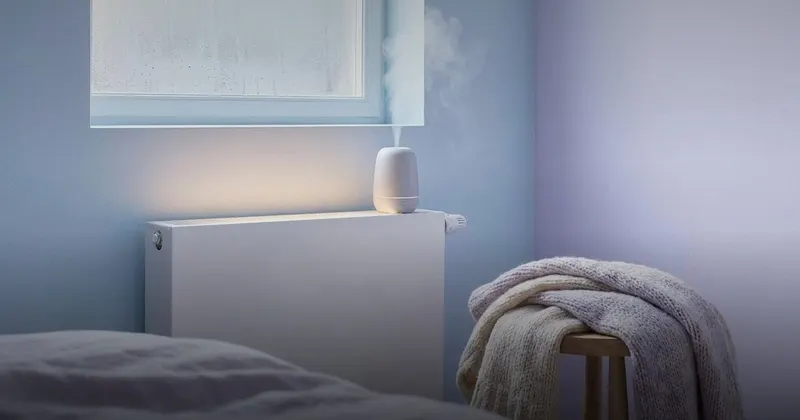
Central heating dries skin because warming cold outdoor air lowers its relative humidity, and heated rooms can sit at 20 to 30% 1. Below about 30%, skin starts to feel dry, and its outer layer can lose water within hours 36. Keeping indoor air near 40 to 50%, cleaning your humidifier often, sealing moisture in at night and taking shorter lukewarm showers may help your barrier cope.
Why does central heating dry out your skin?
Key Takeaways
Cold winter air holds very little water. When your radiator warms it, the water content stays the same while the air's capacity rises, so relative humidity falls. That is the number your skin responds to.
In a one-year study of 43 office buildings across six countries, 42% of workday humidity readings sat below 40%, and levels ran lowest in winter months 2. A Finnish office trial measured unhumidified air at 20 to 30% 1.
What happens to your skin in the first few hours of dry air?
The stratum corneum, your skin's outermost layer of flattened cells, trades water with the air around it. When that air gets drier, the layer gives some of its water up.
In one experiment, healthy volunteers sat in a low-humidity room for 3 or 6 hours. Water content in the stratum corneum dropped significantly on both forearm and cheek by the 3-hour mark, and surface roughness increased 3. In a winter study of a heated indoor room, six hours of exposure raised redness and roughness on the face and increased transepidermal water loss on the forearm 4.
Facial oil appeared to buffer the face in that study, which may be why your shins and hands feel tight before your cheeks do 4.
Does dry air damage the barrier or just dry the surface?
The evidence is mixed. A review of humidity research found that human studies link low humidity to lower stratum corneum water, reduced elasticity and rougher texture, although some evidence suggests low humidity can even strengthen barrier function 5. Water loss results point both ways depending on study and body site.
The most consistent effect is a thirstier surface layer, which most people feel as tightness, flaking and roughness. If your barrier is already compromised by eczema, over-exfoliation or a harsh cleanser, dry air adds to the strain.
Our transepidermal water loss explainer covers how that water loss is measured.
What indoor humidity should you aim for?
In a controlled chamber study, skin and eyes became dry below 30% relative humidity, and the authors concluded indoor air should stay above that line 6. A classic review of indoor air found most humidity-related health problems were minimized between 40 and 60% 7. The US Environmental Protection Agency advises against humidifying a home above 50% 8.
Dust mite populations are smallest below 50% humidity, and most household fungi cannot grow unless humidity passes 60% 7.
Our practical suggestion is roughly 40 to 50%. It sits between that dryness floor and the EPA ceiling, and no study has tested it on skin directly. A cheap hygrometer tells you where you are before you buy anything.
Does a humidifier actually help dry skin?
It may ease symptoms, going by office research. In a cross-over trial with 290 office workers, one building wing was humidified to 30 to 40% while the other ran at a natural 20 to 30%. During humidified weeks, workers reported significantly lower dryness scores, a measure that included dry, itchy or irritated skin 1.
The one-year office study found a similar pattern: higher indoor humidity across the 14% to 70% range was linked to lower odds of women reporting dry or irritated skin 2. A humidifying mist has also been shown to raise stratum corneum water content 5.
A humidifier cannot replace barrier lipids, though; our winter skincare routine guide covers the moisturizer side.
How do you keep a humidifier clean?
A dirty tank is the main downside. Ultrasonic and impeller ("cool mist") units can spray microorganisms and minerals from their water into the room 8.
The EPA's care guidance is simple 8:
- Empty the tank, wipe it dry and refill it every day.
- Clean portable units every third day, scrubbing off scale and film.
- Use water with low mineral content, such as distilled water. A fine white dust on furniture means minerals are leaving the tank.
- Keep steam units away from children, since steam can burn.
- Clean and fully dry the unit before storing it at the end of winter.
Use cleaning products only as the manufacturer directs, then rinse well 8. An older review preferred evaporative or steam units, since cool mist designs can spread whatever grows in the tank 7.
What should change in your routine during heating season?
A few routine changes work alongside better air.
Seal water in overnight
A thin occlusive layer, such as petrolatum over your moisturizer, slows evaporation while you sleep in a heated bedroom. In a human study, petrolatum spread through the stratum corneum and sped up barrier recovery after damage 9. Our slugging guide explains how to do it without a greasy pillow.
Check your moisturizer's lipid mix
A moisturizer built on ceramides, cholesterol and fatty acids supports the lipid layer that dry air strains. In the heated-room study, the side of the face treated with a ceramide cream held up better on texture and elasticity than the untreated side 4. Our ceramide ratio guide shows what to look for on the label.
Exfoliate less often
If you use AHAs, BHAs or a retinoid, consider dropping a night or two per week in winter, especially if you notice stinging. Patch test anything new on your inner arm, introduce one product at a time, and keep wearing SPF by day.
Keep showers short and lukewarm
In a study of 50 volunteers who held one hand in hot water, palm water loss rose from 25.75 to 58.58 g/h/m², about 2.3× (58.58 divided by 25.75, our arithmetic), against 34.96 after cold water 10. It was a hand test, yet it suggests a long hot shower after a day in dry air stacks two stresses.
Which heating-season changes need which fix?
| What changes in winter | What it may do to skin | Fix worth trying |
|---|---|---|
| Indoor humidity falls to 20 to 30% | Stratum corneum loses water, feels tight | Humidify toward 40 to 50%, check with a hygrometer |
| Radiator on all night in the bedroom | Driest hours coincide with sleep | Occlusive layer over moisturizer at night |
| Dry air plus the same exfoliation schedule | Stinging, flaking, redness | Fewer exfoliation nights per week |
| Longer, hotter showers | Higher water loss after bathing | Shorter lukewarm showers, moisturize within minutes |
| Humidifier running with standing water | Microbes and minerals sprayed into the room | Empty daily, clean every third day, distilled water |
| Humidity pushed above 60% | Dust mites and mold thrive | Cap indoor humidity at about 50% |
When is it more than dry air?
Winter dryness usually settles with better air and a steadier routine. Skin that cracks and bleeds, itches enough to disturb sleep, or forms red, scaly patches that ignore moisturizer deserves a look from a GP or dermatologist.
Eczema, psoriasis and contact dermatitis can all flare in winter and may need medical treatment. Low indoor humidity has been linked with more eczema in population studies, so humidity is worth tracking alongside that care 5.
Use This in Your Routine
Skin Bliss is a skincare scanner that checks whether products actually fit your skin, before you buy. Weather-Based Skincare Alerts give you tips based on local humidity, temperature and wind, which can prompt a switch to your winter routine before the first cold snap. They read the weather outside, so keep a hygrometer for the air inside.
The Routine Builder sets AM and PM steps in a weekly schedule view, so cutting exfoliation from four nights to two shows up on the page. Its ingredient-interaction checks can flag overlapping actives on the same night. You can set up your winter routine in Skin Bliss.
Which room in your home runs driest? Measure it this week.
FAQ
Is 30% humidity too low for skin?
It is at the edge. In a controlled study, skin and eyes became dry below 30% relative humidity, and the authors recommended staying above that level 6. Aiming for roughly 40 to 50% gives your skin more margin without encouraging dust mites or mold, which do better once humidity climbs past 50 to 60% 78.
Should you run a humidifier all night?
Many people do, since heated bedrooms often run driest and you spend most of the night there. Keep the room below about 50%, and empty, dry and refill the tank each morning 8. A hygrometer on the nightstand shows whether you are in range.
Can a humidifier make your skin worse?
The risks come mostly from the device. A tank left standing can grow microbes that an ultrasonic unit sprays into the room, and humidity above 50 to 60% can feed mold and dust mites, which may aggravate allergies 78. Daily emptying and cleaning every third day keep it on the helpful side.
Why are my hands and legs drier than my face in winter?
Your face has more oil glands, and sebum appears to act as a partial buffer against dry indoor air. In a heated-room study, water loss rose on the forearm, while facial oil appeared to help steady the face 4. Hands also face frequent washing, often in hot water, which raises water loss further 10. A heavier layer at night may help.
How long until skin feels better after fixing the air?
Symptom changes can show up quickly. In the office humidification trial, dryness scores differed within one-week periods 1. Texture tends to lag behind, since the stratum corneum renews gradually, so give steady humidity and a consistent moisturizer a few weeks. If nothing changes after a month, check in with a GP or dermatologist.

In your browser
Free Skin Quiz: Understand your skin profile in under 5 minutes
Oily or dry is only the start. Find out what your skin actually needs across six skin dimensions, with a plain note on what each one means for your routine. Results appear in your browser, and you can keep them in the app.

Maria combines her background in AI research with a passion for evidence-based skincare. She built Skin Bliss to help people make informed decisions about their skin, backed by science rather than marketing.
Sources (10)
- Reinikainen LM et al. (1992). "The effect of air humidification on symptoms and perception of indoor air quality in office workers: a six-period cross-over trial." *Arch Environ Health*.
- Jones ER et al. (2022). "Indoor humidity levels and associations with reported symptoms in office buildings." *Indoor Air*.
- Egawa M et al. (2002). "Effect of exposure of human skin to a dry environment." *Skin Res Technol*.
- Park EH et al. (2023). "Effects of winter indoor environment on the skin: Unveiling skin condition changes in Korea." *Skin Res Technol*.
- Goad N, Gawkrodger DJ (2016). "Ambient humidity and the skin: the impact of air humidity in healthy and diseased states." *J Eur Acad Dermatol Venereol*.
- Sunwoo Y et al. (2006). "Physiological and subjective responses to low relative humidity." *J Physiol Anthropol*.
- Arundel AV et al. (1986). "Indirect health effects of relative humidity in indoor environments." *Environ Health Perspect*.
- US Environmental Protection Agency (2022). "Indoor Air Facts No. 8: Use and Care of Home Humidifiers." *US EPA*.
- Ghadially R et al. (1992). "Effects of petrolatum on stratum corneum structure and function." *J Am Acad Dermatol*.
- Herrero-Fernandez M et al. (2022). "Impact of Water Exposure and Temperature Changes on Skin Barrier Function." *J Clin Med*.