Journal · Devices, Body & Lifestyle
A Red Light Mask Buyer's Guide Before Black Friday
The best red light mask matches the trials: red near 630 nm, near-infrared near 850 nm, stated irradiance and FDA clearance. Check all four before Black Friday.

Maria Otworowska, PhD, Co-founder of Skin Bliss
· 11 min read
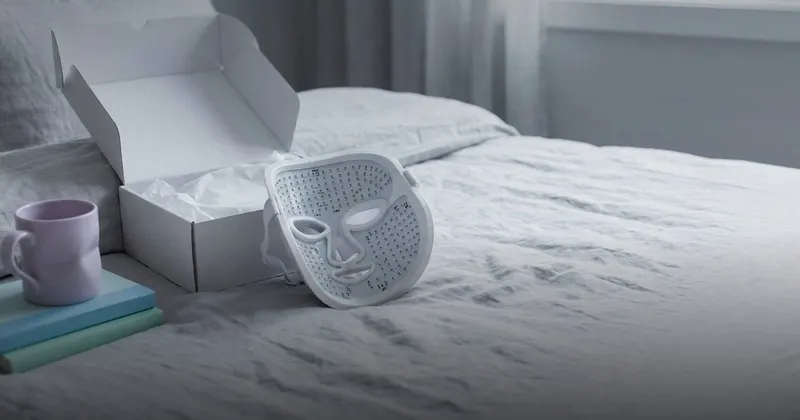
The best red light mask for you is the one whose specs match the studies. Look for red light around 630 to 650 nm, near-infrared around 830 to 850 nm, a stated irradiance, FDA clearance, and eye guidance. Plan on 8 to 12 weeks of regular sessions, and buy where the return window lets you judge the results.
What should you look for in a red light mask?
Key Takeaways
A Black Friday discount lowers the price of a mask without changing what it can do, so check the box against the research first. If you're still deciding whether red light works at all, start with our review of 12 at-home red light studies.
Which wavelengths did the red light mask trials use?
In the trials, red sits around 630 to 640 nm, and near-infrared, light just past what your eyes can see, sits around 830 to 850 nm.
In a split-face trial, 76 people used 633 nm, 830 nm, both, or a sham light twice a week for four weeks. The treated side showed wrinkle reductions of up to 36% and elasticity gains of up to 19% against baseline 1. In a larger trial of 136 volunteers, adding light up to 850 nm gave no advantage over 611 to 650 nm red alone 2.
Home devices in published trials use the same bands: one mask paired 630 nm with 850 nm 3, and another device used 637 and 854 nm 4. A 2026 systematic review of eight home studies with 365 participants found red and near-infrared were the most common choices 5.
A box that lists colours or modes but no wavelength in nanometres can't be compared with any of this.
Does irradiance matter more than the number of LEDs?
It tells you far more about the dose. Irradiance is how much light power lands on each square centimetre of skin, written as mW/cm². Dose, or fluence, is that power multiplied by time, written as J/cm².
One review argues that light therapy has a sweet spot: below a threshold irradiance, a longer session doesn't make up for it, and too much intensity may work against you 7. So a mask with 200 weak LEDs isn't automatically better than one with 60 strong ones.
Home masks are modest. The mask in one sham-controlled home trial was capped at 10 mW/cm² for each wavelength 3. At that ceiling, a 9-minute session works out to no more than about 5.4 J/cm² (our arithmetic, since the paper didn't report a dose). The 136-person trial used about 9 J/cm² per session 2.
More isn't automatically safer. In two forearm safety trials, high doses caused blistering and lasting redness, and the safe ceiling was lower for skin of colour 6. Our guide to red light side effects on darker skin tones covers that.
How long and how often did people use masks in the home trials?
The home trials we found ran for 8 to 12 weeks, with sessions two to five times a week.
In a home split-face pilot, 24 people used the device twice a week for 8 weeks. Elasticity on the treated side pulled ahead at weeks 6 and 8, and the share scoring good improvement rose from 37.5% to 62.5% 4.
The sham-controlled home mask trial asked for 9 minutes, 5 times a week, for 12 weeks. Crow's feet scores differed from the sham group at 8, 12 and 16 weeks, and independent raters judged 86.2% of the full analysis group improved 3.
Check the manual's schedule against your evenings. The American Academy of Dermatology (AAD) says home red light isn't a one-off, so expect upkeep after the first course 8.
What does "FDA cleared" mean on an LED mask?
It means the FDA let the device be sold because it is similar enough to one already on the market, through a 510(k) clearance. Approval is a stricter review meant for the highest-risk devices 9.
The AAD puts it plainly: the FDA clears devices and doesn't approve or certify them, and clearance doesn't tell you how effective a device is 8. Treat "FDA approved" or "FDA certified" on a mask box as a warning sign, since those phrases have no meaning for a device like this 8.
The AAD still recommends a cleared device made for what you want to treat 8. Look up the 510(k) number in the FDA's public 510(k) database and check that the cleared use, such as wrinkles or acne, matches your goal.
Who should skip a red light mask?
The AAD notes that a light-sensitive skin condition such as lupus can worsen under red light, and that red light may not be recommended if a medication makes your skin more sensitive to light 8. If you aren't sure whether any of your medicines do this, ask your pharmacist.
The AAD also notes that darker skin tones are more sensitive to visible light and suggests seeing a dermatologist first 8. Diverse skin types were underrepresented in home trials 5, so the evidence there is thinner.
If you're pregnant or have an ongoing skin or eye condition, ask your doctor before you start. If your skin burns, blisters or stays red for hours, stop and get it checked.
How do you protect your eyes?
Follow the manual exactly. If it tells you to wear goggles, wear the recommended ones every time, and don't swap in sunglasses 8.
In 2019, a major skincare brand recalled its light therapy acne mask in the UK and Ireland, citing a theoretical risk of eye injury for people with certain eye conditions or on medicines that make the eyes more sensitive to light 10.
What results can you realistically expect?
Expect small, gradual changes in texture and fine lines, if you see any. The AAD says results take time, not everyone sees them, and in-office red light is stronger than home devices 8. In one study it cites, more than 90% of people noticed some improvement after 8 treatments over 4 weeks 8.
Side effects were usually mild. In the 12-week mask trial, 6.67% of participants reported an adverse event, and none were serious 3. Long-term effects of years of home use aren't known 8.
Keep the rest of your routine steady so you can judge the mask. If you also start a retinoid or acid, add one product at a time, patch test it and wear SPF by day. For home versus clinic, see our at-home LED mask vs professional guide.
How do you check a Black Friday LED mask deal?
Bring this table to the product page and look for an answer to every row.
| Spec | What the trials used | What to look for on the box |
|---|---|---|
| Red wavelength | 630 to 637 nm 134 | A number in nm, around 630 to 650 |
| Near-infrared | 830 to 854 nm 134 | A number in nm, around 830 to 850 |
| Irradiance | Up to 10 mW/cm² in one home mask 3 | mW/cm² stated, beyond the LED count |
| Session and course | 9 min, 5×/week, 12 weeks 3 | A schedule you can keep |
| Regulatory status | 510(k) clearance 9 | "FDA cleared" plus a 510(k) number |
| Eye safety | Follow device directions 8 | Goggles or eye guidance included |
Then check the return window. Differences showed after 6 to 8 weeks in the home trials 34, so a 30-day policy ends too soon. Prices run from $100 to more than $1,000 8, and our red light mask cost breakdown can help you judge a fair price.
Use This in Your Routine
Take a photo in the same light before your first session, then one a week, in Photo Journal & Visual Progress in the Skin Bliss app. Its side-by-side view and zoom can help you see whether texture or fine lines are moving across 8 to 12 weeks.
Use Log Skin Changes, Mood & Notes to write down any redness, dryness or stinging after a session, so a pattern shows up early. Skin Bliss is a skincare scanner that checks whether products actually fit your skin, before you buy. Find both at getskinbliss.com.
Which mask is in your basket? Save this page and check it against the table before the sale ends.
FAQ
Is an LED face mask worth it?
It can be, if it uses trial-matched wavelengths and you use it for 8 to 12 weeks. Home trials show modest gains in elasticity, texture and fine lines. If you won't keep up several sessions a week, or you take light-sensitizing medication, your money may be better spent elsewhere.
What wavelength should a red light mask have?
Look for red light around 630 to 650 nm and near-infrared around 830 to 850 nm. Those are the bands most published trials used, home devices included. A mask that lists only colours or modes, without nanometre values, can't be compared with the research.
How long does it take to see results from a red light mask?
In home trials, differences appeared after 6 to 8 weeks of regular sessions, and studies ran for 8 to 12 weeks. One mask trial used 9-minute sessions five times a week. Take a photo in the same light each week, since gradual changes are easy to miss in the mirror.
Does "FDA cleared" mean an LED mask works?
No. A 510(k) clearance means the FDA judged the device similar enough to one already sold, which doesn't prove it works. The AAD advises choosing an FDA-cleared device made for your goal, and says "FDA approved" or "FDA certified" have no meaning for a device like this.
Do you need eye protection with a red light mask?
Follow the device's directions. If they call for goggles, wear the recommended ones every session and don't swap in sunglasses. If you have an eye condition, or take medicines that make your eyes more light-sensitive, ask an eye doctor first. A 2019 acne mask recall was issued with exactly those groups in mind.
In your browser
Free Skin Quiz: Understand your skin profile in under 5 minutes
Oily or dry is only the start. Find out what your skin actually needs across six skin dimensions, with a plain note on what each one means for your routine. Results appear in your browser, and you can keep them in the app.

Maria combines her background in AI research with a passion for evidence-based skincare. She built Skin Bliss to help people make informed decisions about their skin, backed by science rather than marketing.
Sources (10)
- Lee SY et al. (2007). "A prospective, randomized, placebo-controlled, double-blinded, and split-face clinical study on LED phototherapy for skin rejuvenation: clinical, profilometric, histologic, ultrastructural, and biochemical evaluations and comparison of three different treatment settings." *J Photochem Photobiol B*.
- Wunsch A, Matuschka K (2014). "A controlled trial to determine the efficacy of red and near-infrared light treatment in patient satisfaction, reduction of fine lines, wrinkles, skin roughness, and intradermal collagen density increase." *Photomed Laser Surg*.
- Park SH et al. (2025). "Clinical study to evaluate the efficacy and safety of home-used LED and IRED mask for crow's feet: A multi-center, randomized, double-blind, sham-controlled study." *Medicine (Baltimore)*.
- Ng JNC et al. (2020). "Efficacy of home-use light-emitting diode device at 637 and 854-nm for facial rejuvenation: A split-face pilot study." *J Cosmet Dermatol*.
- Das RK et al. (2026). "Efficacy and Safety of At-Home Light-Emitting Diode Photobiomodulation for Facial Rejuvenation: A Systematic Review." *Aesthetic Plast Surg*.
- Jagdeo J et al. (2020). "Safety of light emitting diode-red light on human skin: Two randomized controlled trials." *J Biophotonics*.
- Barolet D (2021). "Near-Infrared Light and Skin: Why Intensity Matters." *Curr Probl Dermatol*.
- American Academy of Dermatology (2024). "Is red light therapy right for your skin?" *AAD*.
- U.S. Food and Drug Administration (2026). "Is It Really 'FDA Approved'?" *FDA*.
- Association of Optometrists (2019). "Eye injury risk prompts recall of Neutrogena light therapy acne mask." *AOP*.