Journal · Devices, Body & Lifestyle
Winter Body Skincare: KP, Rough Elbows and Dry Legs in One Routine
A winter body skincare routine needs short warm showers, a thick cream on damp skin, and urea, lactic or salicylic acid for KP, rough elbows and dry legs.

Maria Otworowska, PhD, Co-founder of Skin Bliss
· 11 min read
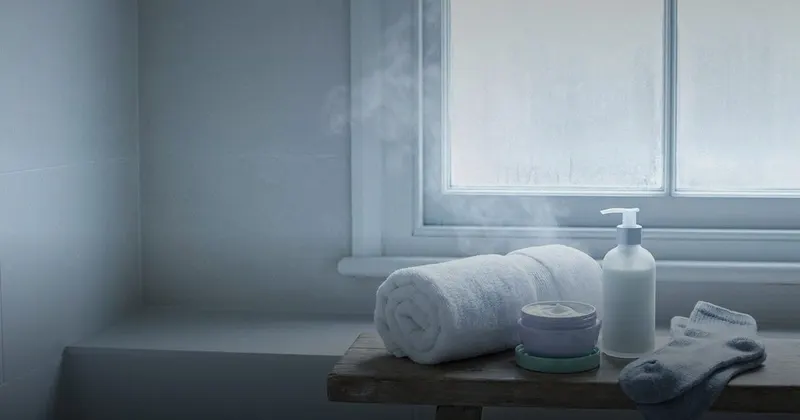
A winter body skincare routine can stay short. Take brief, warm showers instead of long hot ones, pat dry and put a thick cream on while your skin is still damp. On rough spots, add a urea or lactic acid cream, or salicylic acid for keratosis pilaris bumps, then cut back to a few nights a week.
Why does your body get so dry in winter?
Key Takeaways
Your face has plenty of its own oil, and in winter that seems to help. In a heated-room study, forearm skin lost more water after six hours, while facial oil appeared to protect the face 2. That may be why your shins feel tight before your cheeks do.
The shins are also the most common site for asteatotic eczema, a rash caused by very dry skin, and low humidity, fan heaters and frequent soapy washing all add to it 3. Keratosis pilaris (KP), the rough little bumps on the backs of arms and thighs, follows the seasons too. In a survey of 49 people with KP, 80% noticed seasonal changes, and 47% of those said it got worse in winter 1.
Body lotion vs body cream: which works better in winter?
For winter dryness, a cream usually does more than a lotion. The American Academy of Dermatology (AAD) suggests a thick cream or ointment rather than a lotion for KP, ideally one with urea or lactic acid 4. A German expert position paper on dry skin adds that the drier your skin looks, the more lipid your product should contain, with water-in-oil formulas preferred 5.
Keep a lighter lotion for mornings under jeans if you like, and save the richer cream for shins, elbows and knees at night.
The same paper rates urea as the dry-skin ingredient with by far the best evidence, especially alongside other moisturising ingredients and ceramides 5. See also our guide on whether your body needs a barrier serum.
How should you shower and moisturise in winter?
Keep showers short and warm. For KP, the AAD suggests a bath or shower of 20 minutes or less, in warm rather than hot water, once a day, with a mild cleanser instead of bar soap 4.
Skip the scrub, since scrubbing tends to irritate skin and can make KP worse 4. Shaving or waxing over KP can also bring on more bumps 4.
Then pat your skin dry and apply your cream within 5 minutes of getting out, while your skin is still damp 4. If your bedroom air feels dry, a humidifier may help as well 4. Our indoor heating and dry skin guide covers humidity targets and what hot water does to your barrier.
Which body acids help rough, dry skin?
Urea, lactic acid and salicylic acid have the clearest trial data for body skin. Each helps loosen built-up dead skin cells, which is why the AAD lists all of them as options for KP 4.
Urea for dry legs and rough elbows
Urea is one of your skin's own natural moisturising factors, and it exfoliates more at higher strengths 7. In a small study of 20 older adults with dry arms or legs, a 10% urea cream used twice a day reduced dryness, itch and visible scaling within 14 days, and nobody reported stinging 6.
For KP, a 20% urea cream used once a day improved skin smoothness after 1 and 4 weeks in an open-label study of 30 adults 7. With no comparison group, treat that as an early sign. A 10% urea product suits all-over use on dry legs, while a 20% cream makes more sense for rough elbows, knees and KP patches.
Lactic acid for flaky skin and KP
Lactic acid is an alpha hydroxy acid (AHA). In a double-blind trial on moderate to severe dry skin, a 12% ammonium lactate lotion, a form of lactic acid, used twice a day for 3 weeks worked better than a 5% lactic acid lotion, and the gap held for 3 weeks after people stopped 8.
For KP, a 10% lactic acid cream applied twice a day for 3 months reduced bumps by 66% on average, and skin hydration improved 9. In one survey, 43.63% of dermatologists named it their first-line KP treatment 10. Our AHA body wash guide compares lactic and glycolic acid washes for KP.
Salicylic acid for bumpy KP
Salicylic acid is a beta hydroxy acid (BHA). In the same 3-month trial, a 5% salicylic acid cream reduced KP bumps by 52%, against 66% for lactic acid, and side effects were limited to mild irritation 9. It came second in the dermatologist survey, named first-line by 20.72% 10.
Start with one acid rather than layering two on the same patch of skin.
What can you realistically expect from KP treatment?
Expect smoother skin rather than skin with no bumps at all. The AAD says KP can't be cured, so the goal is a maintenance plan, which often means treating your skin a few times a week 4. In the 1994 survey, KP sat on the arms in 92% of people and the legs in 59%, and it eased with age in 35% 1.
Results also fade when you stop. Over 60% of surveyed dermatologists saw KP come back within three months of stopping salicylic acid and over-the-counter moisturiser treatment 10. Give a new routine at least 4 weeks, the first check-in point in the lactic acid trial 9.
Retinoids are on the AAD's KP list too 4. Our guide to using retinol on your body covers how to start and how to fit it around acids.
How do you build one winter body routine?
One routine can cover your shins, elbows and the backs of your arms:
- Every shower: short and warm, a mild cleanser, no scrub.
- Within 5 minutes: a 10% urea cream or another thick cream wherever skin feels dry.
- Treatment nights: lactic or salicylic acid on KP patches, 20% urea on elbows and knees.
- Once skin is smoother: acids on a few nights a week, with the daily cream as before.
Patch test any new acid on your inner arm first, and add one new product at a time. Wear SPF on treated skin that sees daylight, and stop the acid for a few days if your skin turns raw or irritated 4.
Which ingredient fits which winter body concern?
| Concern | Ingredient | How often | Watch for |
|---|---|---|---|
| Dry, flaky shins | 10% urea cream 6 | Twice daily in the trial | Itchy, cracked patches: see a doctor |
| Rough elbows and knees | 20% urea cream 7 | Once daily in the trial | Raw skin: pause a few days 4 |
| KP on arms and thighs | 10% lactic acid cream 9 | Twice daily, then a few times a week 4 | Mild irritation 9 |
| Bumpy KP | 5% salicylic acid cream 9 | Twice daily, then a few times a week 4 | Mild irritation, one acid at a time |
| Very dry skin all over | 12% ammonium lactate lotion 8 | Twice daily in the trial | Daylight on treated skin: wear SPF |
| Tightness after showers | Thick cream on damp skin 4 | Within 5 minutes of showering | Long, hot showers 4 |
When should you see a doctor instead?
Some winter dryness is a skin condition that needs more than a body cream. Asteatotic eczema most often starts on the shins and can look like crazy paving, with diamond-shaped plates of skin split by red lines 3.
See a GP or dermatologist if you have an itchy rash that keeps you awake, cracked or bleeding skin, thick red scaly patches that could be psoriasis, or eczema that flares every winter. The same goes for KP that won't budge with home care 4. Eczema and psoriasis may need medical treatment, so hold off on stronger acids until you've been seen.
Use This in Your Routine
The Routine Builder sets out AM and PM steps in a weekly schedule view, so your urea cream can go in every evening and lactic acid on three set nights. Its automatic ingredient-interaction checks can flag body retinol and an acid landing on the same night.
Weather-Based Skincare Alerts give tips based on local humidity, temperature and wind, which can nudge you toward the richer cream before a cold, windy week. Skin Bliss is a skincare scanner that checks whether products actually fit your skin, before you buy. You can set up your winter body routine in Skin Bliss.
Which part of your body gets driest in winter? Save this for your next shower.
FAQ
Is urea or lactic acid better for dry legs?
Both have trial support. A 10% urea cream eased dryness, itch and scaling on arms and legs within 14 days in a small study, and a 12% ammonium lactate lotion beat a 5% lactic acid lotion for moderate to severe dry skin. We found no trial comparing the two on legs, so pick the one your skin tolerates.
Does keratosis pilaris get better in summer?
For many people, yes. In a survey of 49 people with KP, 80% noticed seasonal changes, and about half of those said it improved in summer while 47% said it worsened in winter. Since dry skin tends to set off flares, steady moisturising through winter may help.
Should you put body lotion on wet or dry skin?
Put it on damp skin. The American Academy of Dermatology suggests applying moisturiser within 5 minutes of bathing, after gently patting your skin dry. A thick cream or ointment usually helps very dry skin more than a thin lotion, especially on shins and elbows.
Can you use a urea cream every day?
In the studies, people used 10% urea twice daily for dry arms and legs and 20% urea once daily for keratosis pilaris, with no significant side effects reported. Once your skin is smoother, a few treatment nights a week may be enough. Stop for a few days if your skin turns raw or irritated.

In your browser
Free Skin Quiz: Understand your skin profile in under 5 minutes
Oily or dry is only the start. Find out what your skin actually needs across six skin dimensions, with a plain note on what each one means for your routine. Results appear in your browser, and you can keep them in the app.

Maria combines her background in AI research with a passion for evidence-based skincare. She built Skin Bliss to help people make informed decisions about their skin, backed by science rather than marketing.
Sources (10)
- Poskitt L, Wilkinson JD (1994). "Natural history of keratosis pilaris." *Br J Dermatol*.
- Park EH et al. (2023). "Effects of winter indoor environment on the skin: Unveiling skin condition changes in Korea." *Skin Res Technol*.
- Oakley A (2014). "Asteatotic eczema." *DermNet*.
- American Academy of Dermatology (2021). "Keratosis pilaris: Self-care." *AAD*.
- Augustin M et al. (2019). "Diagnosis and treatment of xerosis cutis - a position paper." *J Dtsch Dermatol Ges*.
- Lacarrubba F et al. (2021). "10% urea cream in senile xerosis: Clinical and instrumental evaluation." *J Cosmet Dermatol*.
- McCormick E et al. (2024). "Evaluation of a Moisturizing Cream with 20% Urea for Keratosis Pilaris." *J Drugs Dermatol*.
- Rogers RS 3rd et al. (1989). "Comparative efficacy of 12% ammonium lactate lotion and 5% lactic acid lotion in the treatment of moderate to severe xerosis." *J Am Acad Dermatol*.
- Kootiratrakarn T et al. (2015). "Epidermal permeability barrier in the treatment of keratosis pilaris." *Dermatol Res Pract*.
- Greenzaid J et al. (2023). "Keratosis Pilaris: Treatment Practices of Board-Certified Dermatologists." *J Drugs Dermatol*.