Journal · Devices, Body & Lifestyle
Skincare Advent Calendars 2026: Are They Worth It for Your Skin?
A skincare advent calendar is worth it when you'd use most doors and cost per ml beats full sizes. How to check value, actives, fragrance and patch testing.

Maria Otworowska, PhD, Co-founder of Skin Bliss
· 10 min read
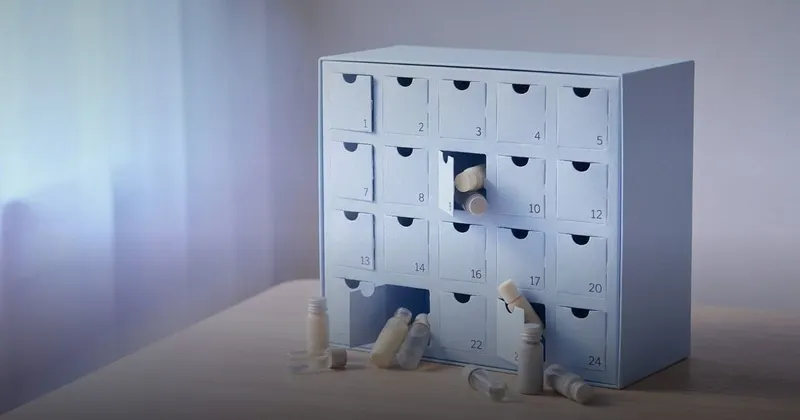
A skincare advent calendar is worth it when you would use most of the products anyway, the cost per ml beats buying them separately, and the formulas fit your skin. Check the full ingredient lists before you buy, count the actives and fragranced leave-ons, and open new products slowly, one at a time.
Are skincare advent calendars worth it in 2026?
Key Takeaways
Circana data reported by Cosmetics Business shows UK prestige beauty calendar sales value up 276% year on year in one late-November week of 2025 (17 to 23 November), while volume rose 92% 1. Higher spend per calendar makes the maths worth doing.
How do you judge the value of a beauty advent calendar?
Start by ignoring the "worth" figure on the box. It adds up full retail prices for every door, including the ones you will never use. Three numbers tell you more:
- Full size vs minis. Count the full-size doors. A serum mini may last only a week or two.
- Cost per ml. Divide the price by the total ml of the products you would use, then compare with the same products bought in full size.
- Your use rate. Cross out every product you know you won't use.
A made-up example shows why the use rate matters. A calendar costs 100 in your currency and holds 300 ml of product. You would use 180 ml of it, so your real cost is about 0.56 per ml, well above the 0.33 you get by counting every door. If the full sizes cost less per ml, you are paying for the experience, which is a fine reason to buy as long as you know it.
Why check the ingredient lists before you buy?
A calendar is a routine you did not build. Twenty-four products from different brands can add up to several retinoids, exfoliating acids and vitamin C serums arriving in the same few weeks, and many people describe their skin as reactive. A 2020 meta-analysis of 26 studies covering 51,783 people found that 71% reported sensitive skin to some degree, and 40% called it moderately or very sensitive 2. The authors add that questionnaire studies may overestimate the true figure. An expert group of dermatologists defines sensitive skin as stinging, burning or itching in response to things that shouldn't cause it, sometimes on skin that looks completely normal 3.
Many brands publish the contents before launch or on the product page. Sort the products into three groups: strong actives (retinoids, AHAs, BHAs, vitamin C, benzoyl peroxide), leave-on products with fragrance, and gentle basics like cleansers, moisturizers and SPF. A calendar with eight actives needs a plan, and our guide to stacking three actives without wrecking your barrier covers how to space them.
What should sensitive skin look for in an advent calendar?
Fragrance is the count to know. Confirmed fragrance allergy is uncommon: a patch-test study of 3,119 adults across five European countries estimated clinically relevant fragrance contact allergy at 1.9%, with the highest single marker, fragrance mix I, at 2.6% 4. Rates in women were about twice those in men.
Exposure still matters. In the same population, sensitive skin was linked both to use of scented products and to fragrance allergy, and exposure to scented leave-on products was associated with fragrance allergy 5. A calendar where most leave-on doors are fragranced adds a lot of new exposure in one month.
EU labels are getting more detailed this season. Regulation (EU) 2023/1545 expands the list of fragrance allergens that must be named on the label when they exceed 0.001% in leave-on products or 0.01% in rinse-off products 6. Products placed on the EU market after 31 July 2026 must use the new labels, while older stock can stay on sale until 31 July 2028 6. Names like linalool or limonene near the end of a list signal fragrance components, which can come from essential oils even when "parfum" is absent.
What should you check before buying a skincare advent calendar?
| Check | Why it matters | How to do it |
|---|---|---|
| Full-size door count | Minis inflate the box value | Count full sizes on the published contents list |
| Cost per ml of what you'd use | Retail value counts products you'll skip | Price divided by the ml you would actually use |
| Strong actives | Several retinoids or acids at once raise irritation risk | Scan each ingredient list for retinol, retinal, glycolic, lactic, salicylic acid |
| Fragranced leave-ons | Leave-on scent exposure is linked to fragrance allergy | Look for parfum, fragrance and named allergens like linalool |
| Duplicates of your routine | Doubles lead to waste or overuse | Compare against products you already own |
| Return and gifting options | Misses need somewhere to go | Check the retailer's return terms for opened boxes |
If fewer than half the doors pass these checks for your skin, the calendar is probably a better gift for someone else than a buy for you.
How do you open 24 new products without irritating your skin?
Open the doors on schedule if you enjoy the ritual, but don't start each product the day you open it. In a hospital series of 1,004 people with reactions to cosmetics, 51.79% of reactions appeared within 3 days of starting the product, and creams and emulsions were linked with reactions in the first week 7. That series only covers people who reacted, yet it suggests a practical rule: one new leave-on product every 3 days at most.
A simple patch-test plan:
- Apply a little to the inner arm once or twice a day for several days.
- If there's no redness, itch or stinging, try a small area of the face.
- Add only one active at a time, and never start two new actives in the same week.
Retinoids and acids may cause dryness, stinging, temporary flaking or a short spell of breakouts (often called purging) while skin adjusts. Wear SPF by day while using them. If your skin already feels tight or stings with plain moisturizer, check the signs of barrier damage before adding anything new, and see a doctor or pharmacist about a reaction that spreads, swells or lasts.
What should you do with products that don't suit your skin?
Decide before you open anything. Sealed misses make good gifts, swaps or donations.
Opened products need a different plan. A UK study of donated used makeup, from lipstick to mascara, found bacteria in about 79% to 90% of the products tested 8. That was makeup rather than skincare, but the lesson carries over: once a product has touched fingers or skin, keep it for yourself or throw it away. Don't pass opened minis on.
Check the period-after-opening symbol, the open jar with a number like "6M", and write the opening date on each mini with a marker. Preservatives help keep products stable for that window. Minis you like but can't use yet can stay sealed until your routine has room.
Use This in Your Routine
The quickest way to judge a calendar is to check every door against your skin before you pay. Skin Bliss is a skincare scanner that checks whether products actually fit your skin, before you buy.
Once the calendar arrives, lay the products out and take one photo with Shelf Analysis: it reads the whole set together as a routine and can flag gaps or clashes, like three exfoliating acids in one set. The Product Compatibility Checker can then flag overlapping actives before you add a new serum to the retinol you already use. Our guide to the app that scans skincare ingredients shows how a single-product scan works, and Skin Bliss can run that check on each mini before it joins your routine. Start at getskinbliss.com.
Which door are you most curious about this year? Save this checklist for the day the contents list drops.
FAQ
Are beauty advent calendars worth the money?
They can be, when you would use most of the products and the cost per ml of those products beats buying them separately. The stated retail value counts every door at full price. Cross out the products you won't use, divide the price by the ml that remain, and compare that with the full-size prices of the same products.
Is a skincare advent calendar a good idea for sensitive skin?
It can be, with planning. Check every ingredient list before buying and count the leave-on products that contain fragrance or strong actives. After it arrives, patch test each leave-on product on the inner arm for several days and add only one new product every few days. Gift unopened any door with an ingredient you have reacted to before.
Can I use all the actives in a calendar at once?
It's safer not to. Starting several retinoids, exfoliating acids or vitamin C serums in the same week makes irritation more likely and makes it hard to tell which product caused a problem. Introduce one active at a time, wait at least a few days before adding another, patch test first, and wear SPF during the day while using retinoids or acids.
How long do minis from an advent calendar last once opened?
Check the period-after-opening symbol on each product, an open jar icon with a number such as 6M or 12M. That is how long the product is expected to stay in good condition after opening. Write the opening date on the mini with a marker, keep lids closed, and discard anything that changes smell, colour or texture before that date.
What should I do with advent calendar products I can't use?
Keep the unopened ones sealed and gift, swap or donate them; many community groups accept unopened toiletries. Throw away opened products that don't suit you rather than passing them on, since products that have touched fingers or skin can pick up bacteria. If you haven't opened the calendar at all, check the retailer's return policy first.
In your browser
Free Skin Quiz: Understand your skin profile in under 5 minutes
Oily or dry is only the start. Find out what your skin actually needs across six skin dimensions, with a plain note on what each one means for your routine. Results appear in your browser, and you can keep them in the app.

Maria combines her background in AI research with a passion for evidence-based skincare. She built Skin Bliss to help people make informed decisions about their skin, backed by science rather than marketing.
Sources (8)
- Hancock L (2026). "Inside the creation and curation of Liberty and Lookfantastic's beauty advent calendars." *Cosmetics Business (Circana data)*.
- Chen W et al. (2020). "The prevalence of self-declared sensitive skin: a systematic review and meta-analysis." *J Eur Acad Dermatol Venereol*.
- Misery L et al. (2017). "Definition of Sensitive Skin: An Expert Position Paper from the Special Interest Group on Sensitive Skin of the International Forum for the Study of Itch." *Acta Derm Venereol*.
- Diepgen TL et al. (2015). "Prevalence of fragrance contact allergy in the general population of five European countries: a cross-sectional study." *Br J Dermatol*.
- van Amerongen CCA et al. (2021). "Skin exposure to scented products used in daily life and fragrance contact allergy in the European general population - The EDEN Fragrance Study." *Contact Dermatitis*.
- European Commission (2023). "Commission Regulation (EU) 2023/1545 of 26 July 2023 amending Regulation (EC) No 1223/2009 of the European Parliament and of the Council as regards labelling of fragrance allergens in cosmetic products." *Official Journal of the European Union*.
- Dong C et al. (2023). "Analysis of Adverse Reactions of Cosmetics in Chinese Han Population in Recent Five Years." *Clin Cosmet Investig Dermatol*.
- Bashir A et al. (2020). "Microbiological study of used cosmetic products: highlighting possible impact on consumer health." *J Appl Microbiol*.